This manual is for IT FPX 4157 Assessment 1, start to submission. The opening deliverable in Networking Architectures normally asks for the part students want to skip: the requirements, and a design that can be traced back to them. A topology chosen because it is the one you know is an opinion, and a topology chosen because a stated requirement forced it is engineering, and the criteria can tell the difference from the first page. Marks live in requirements written so they could be tested after the network is built, and in segmentation drawn by trust and function rather than by which room a machine sits in. Below is the method our tutors use for it, a structure that maps to the criteria, and an annotated sample excerpt. Prefer to hand it off? A premium original sample for this exact assessment comes back in 24 to 48 hours, revised free until it meets the guide. Capella's catalog lists the course as IT-FPX4157, and some courserooms print IT4157; both point to this same Assessment 1.
One honesty note before the manual: Capella revises courses and scoring guides over time, so always write to the exact scoring guide attached to your assessment in the courseroom. The course identity above is verified on capella.edu; the method and structure below are our tutors' approach to it, not Capella's official rubric text.
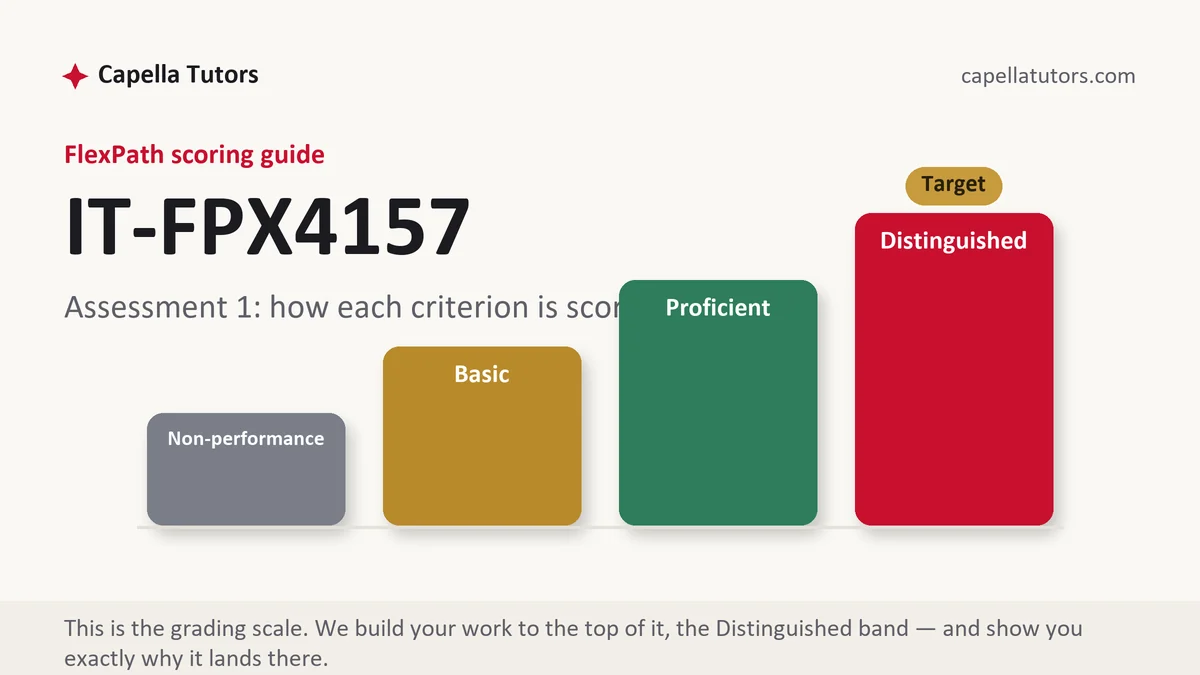
How IT FPX 4157 Assessment 1 is scored
FlexPath assigns levels, not marks. Every criterion on your guide ends up at one of four descriptions, and the description above the one you are at is the instruction you needed:
| Level | What it means on a requirements and segmentation design |
|---|---|
| Distinguished | Requirements are numbered and measurable, every design decision cites the requirement it serves, and each boundary comes with what is permitted to cross it. One extra move is written into each criterion; go and take it. |
| Proficient | A sound design with requirements present and segments defined. Competent work in which some decisions still trace back to preference rather than to a numbered need. |
| Basic | A topology described with a requirements section that says high availability and good performance. The commonest first attempt in this course. |
| Non-performance | A required element is absent, most often the requirements themselves or the rules across a boundary. Nothing else in the design can compensate for it. |
Anything in your design that cannot be traced to a numbered requirement is either an assumption you should declare or a component you should delete. Writing that sentence into your own method is most of what separates the top of this guide from the middle.
The IT FPX 4157 Assessment 1 method, step by step
-
Write requirements that could be tested after the build
Not high availability, but no more than four hours of unplanned downtime per site per year. Not room to grow, but capacity for a third more devices in the warehouse within two years on the same distribution hardware. Requirements written that way constrain the design honestly and hand you the evaluation section at the end, because you can walk each row and say how the design meets it.
-
Count what you are actually designing for
Take a regional food bank with a 40,000 square foot warehouse, an office wing, a volunteer check-in area, and a donor database. Write down the users at each location, the applications that matter, what those applications tolerate in delay and loss, the growth to plan for, and the budget. Numbers first, drawings later, because a topology chosen before the count is a guess with a diagram attached.
-
Group by trust and function, not by geography
Warehouse scanners, office workstations, the donor database, building systems such as refrigeration monitoring, and volunteer devices are five populations with five different levels of trust, and putting them on one flat network because they share a building is the decision the segmentation criterion exists to catch. Name each segment for what it holds, not for where it lives.
-
Write the rule for every boundary you draw
A segment with no stated policy across its edge is a line on a picture. Say what may cross, in which direction, initiated by whom, and where the rule is enforced. Volunteer devices reaching the internet and nothing else, scanners reaching one inventory service on one port, and the donor database reachable only from a named application segment are three sentences that turn a drawing into a design.
-
Choose the structural model and name it
Say whether you are using an access tier, a distribution tier where policy and aggregation happen, and a core that only moves traffic, or whether you are collapsing distribution and core because the site is small. Both are correct in the right place, and the criteria reward the candidate who names the model, justifies it against a numbered requirement, and says what would make the other choice right.
-
Close the loop and self-score
Add an evaluation section that walks each numbered requirement and states how the design satisfies it, then declare every assumption you made where the scenario was silent. Mark each criterion D, P, B, or N yourself, revise the rows that fall short, and upload early because an evaluation can take two business days.
A structure that maps to the criteria
The word counts are the shape our tutors plan a design document around rather than a Capella rule; diagrams and tables sit outside them.
| Section | What it must do | Guide |
|---|---|---|
| Organization and constraints | Sites, users, applications, growth expectation, budget, and anything the scenario fixed for you. | ~250 words |
| Requirements | Numbered and measurable rows, each with a source or a declared assumption behind the figure. | ~300 words |
| Segmentation | Each segment, what it holds, why it is separate, and the population it serves. | ~300 words |
| Boundary policy | What crosses each edge, in which direction, initiated by whom, and where the rule is enforced. | ~250 words |
| Structural model | The tiers or the fabric, justified against numbered requirements, with the rejected alternative named. | ~250 words |
| Evaluation and sources | Each requirement walked against the design, assumptions declared, and specifications cited in current APA. | ~200 words |
Annotated sample excerpt
A short piece of original model writing from our team, at the level the top of the guide describes. Study how each claim points back at a number, then do the same.
Segment 4 carries the warehouse handheld scanners and exists separately from the office segment because requirement R-07 limits those devices to a single inventory service, and the scanners run a vendor firmware image that the food bank cannot patch on its own schedule.1 Traffic from Segment 4 is permitted outbound to one application host on one port, is not permitted to reach the donor database segment in any direction, and is not permitted to originate any connection to the internet, with all three rules enforced at the distribution tier rather than on the access switches.2 Refrigeration monitoring sits in Segment 6 rather than beside the scanners despite similar trust, because its controller needs an outbound path to a vendor service that no other segment is allowed, and mixing them would have widened the scanner policy to accommodate it.3
- 1Cites the numbered requirement that forced the separation and gives the unpatchable device as the reason. Traceability plus a real constraint is what the top column is describing.
- 2States the policy in both directions and names the enforcement point. A boundary with no rule and no enforcer is decoration on a drawing.
- 3Explains why two similar populations were still split, which shows the reasoning rather than the outcome. Explaining a near-miss decision is the move most designs never make.
The full premium sample for your exact assessment, written fresh to your scoring guide and issue, is free to request. Study it, revise it into your own voice, and submit work you understand.
The five mistakes that cost Distinguished
- A requirements section made of adjectives. Fast, secure, and reliable cannot be tested, so no reader can tell whether the design met them.
- Segments drawn by building rather than by trust. One network per floor puts an unpatchable device beside a database and calls it tidy.
- Boundaries with no policy. A line on a diagram enforces nothing, and the criterion is asking what crosses it and who allows that.
- A structural model used without being named. Drawing three tiers without saying why they exist leaves the justification row empty.
- Assumptions made silently. Where the scenario was quiet you invented a number, and declaring it is the difference between judgment and guesswork.
Pre-submission checklist
- Every requirement is numbered and stated so it could be tested after the build
- User counts, applications, tolerances, growth, and budget all appear as figures
- Segments are defined by trust and function, each with the population it serves
- Every boundary has a policy with a direction, an initiator, and an enforcement point
- The structural model is named and justified against a numbered requirement
- An evaluation section walks each requirement, assumptions are declared, and rows self-scored
Design due and the requirements section is empty?
Send the scenario, the site details, and the criteria. A premium original returns inside 24 to 48 hours with numbered measurable requirements, segments drawn by trust, and a policy written for every boundary. The first sample is free.