This manual is for IT FPX 4076 Assessment 3, start to submission. The final deliverable in this course is usually the program rather than a document: a plan that says which controls exist, how each one is tested, what gets reported upward, and who decides when a number goes the wrong way. It is graded on measurement and on realism. A plan that assumes unlimited funding and unlimited headcount will not persuade an evaluator who has worked anywhere, so the work includes sequencing and saying what you would drop if the budget were cut. Below is the method our tutors use for it, a structure that maps to the criteria, and an annotated sample excerpt. Prefer to hand it off? A premium original sample for this exact assessment comes back in 24 to 48 hours, revised free until it meets the guide. Capella's catalog lists the course as IT-FPX4076, and some courserooms print IT4076; both point to this same Assessment 3.
One honesty note before the manual: Capella revises courses and scoring guides over time, so always write to the exact scoring guide attached to your assessment in the courseroom. The course identity above is verified on capella.edu; the method and structure below are our tutors' approach to it, not Capella's official rubric text.
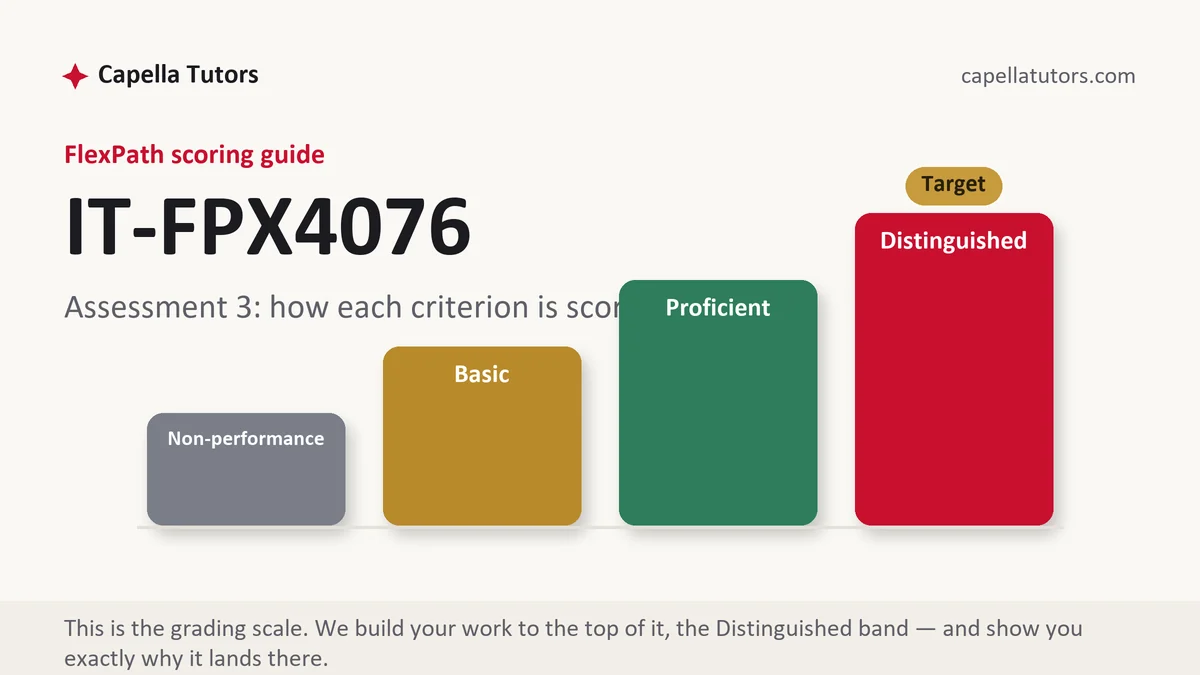
How IT FPX 4076 Assessment 3 is scored
Grades here are levels, not scores. Every criterion lands at one of four places on the guide, and the wording at each place tells you what to write:
| Level | What it means on a management plan |
|---|---|
| Distinguished | Controls are testable with a named operator, a frequency, and an artifact, indicators carry targets and tolerances, and the plan says what happens when funding is reduced. One extra move is written into each criterion; take it. |
| Proficient | A complete plan with controls, testing, and reporting all present. Credible work that has not yet been costed or sequenced. |
| Basic | A restatement of the policy set with headings like assurance and monitoring above paragraphs of intent. |
| Non-performance | A required element is absent, most often the testing method or the reporting audience. An empty section decides its own row. |
The habit worth building is separating the obligation from the thing that proves the obligation happened. Ask of each control you name who operates it, how often, and what artifact it leaves behind, and anything that cannot answer all three is a statement of intent under a different heading.
The IT FPX 4076 Assessment 3 method, step by step
-
Build the control inventory before the narrative
One row per control, with the obligation it serves, the owner by position, the frequency, and the evidence it produces. Take a franchised auto-parts chain with 62 stores and a small central technology team, and the inventory immediately shows you which controls are central and which depend on store managers, which is the distinction the rest of the plan turns on.
-
Design the test, not just the control
For each control say how compliance will be checked, what will be sampled, what evidence is retained, and what conclusion the test can support. A control nobody tests is an assumption, and the criteria treat assumption and control as different things even when the paperwork looks the same.
-
Do the sampling arithmetic and project it honestly
Suppose 340 third-party accounts have access to the store systems and your test samples 30 of them. Three have no recorded business owner, a 10 percent defect rate, which projects to roughly 34 accounts across the population. Say that the projection is an estimate rather than a count, and add the follow-up a tester is paid for: a defect rate at that level justifies widening the sample rather than closing the finding.
-
Choose few indicators and give each one a target
A number reported with no target cannot tell a reader whether to act. Pick a handful that connect to decisions, attach a target, a tolerance, and a trend to each, and keep the detailed register with the owners rather than pushing it upward. Then name the audience and the cadence, because an indicator with no reader is a spreadsheet.
-
Escalate by rule instead of by judgment
Write down what happens when a finding recurs, when a threshold is breached twice, or when a remediation date slips. Rules remove the negotiation that quietly buries repeat findings, and a plan that states them is describing governance rather than describing goodwill.
-
Cost it, sequence it, then self-score
Put the program in phases with what each phase buys, and say plainly what you would defer if funding fell by a quarter. Then mark every criterion D, P, B, or N against the guide, fix the rows you cannot defend, and submit early enough that a two-business-day evaluation leaves time for a revision.
A structure that maps to the criteria
These proportions are how our tutors plan a program document rather than limits set by Capella; weight any section your scoring guide weights.
| Section | What it must do | Guide |
|---|---|---|
| Scope and governance | What the program covers, who owns it, the decision bodies, and how authority flows to them. | ~200 words |
| Control inventory | Each control with its obligation, operator by position, frequency, and the evidence it produces. | ~350 words |
| Testing and assurance | Method, sample, evidence retained, findings, and the projection from sample to population. | ~300 words |
| Risk register | Entries with treatment, owner, review date, and the decision taken, plus how the register stays current. | ~250 words |
| Reporting | The indicator set with targets and tolerances, the audiences, the cadence, and the escalation rules. | ~250 words |
| Resources and sources | Phasing, what each phase buys, what is deferred under a budget cut, and references in current APA. | ~200 words |
Annotated sample excerpt
A single original model passage from our team, pitched where the guide's top column sits. Take the structure of the reasoning, then run your own numbers.
Test AC-04 sampled 30 of the 340 active third-party accounts against requirement 5.1, which obliges every non-employee account to have a recorded business owner and a documented review within the preceding twelve months.1 Three sampled accounts had no owner recorded, a defect rate of 10 percent, which projects to approximately 34 accounts across the population; the projection is an estimate from a small sample rather than a count, and the sample will be extended to 100 accounts before this finding is closed.2 Because AC-04 recorded the same defect class in the previous quarter, the escalation rule in section 6.4 applies automatically, and the finding is reported to the audit committee rather than resolved inside the technology team.3
- 1Names the test, the sample, the population, and the requirement being tested, so a reader can see exactly what was checked and against what.
- 2Projects the result and then limits the projection in the same sentence, which is the honesty an assurance criterion is written to reward, and states the next action rather than closing early.
- 3Applies a written escalation rule instead of exercising discretion. Repeat findings that escalate by rule are the difference between a program and a series of conversations.
The full premium sample for your exact assessment, written fresh to your scoring guide and issue, is free to request. Study it, revise it into your own voice, and submit work you understand.
The five mistakes that cost Distinguished
- Controls listed without operators. A control with no named position behind it belongs to nobody and will be tested by nobody.
- Testing described as ongoing monitoring. Without a sample, an evidence type, and a conclusion, there is no test for an evaluator to grade.
- Indicators reported without thresholds. A figure with no target leaves the reader unable to tell a good quarter from a bad one.
- A risk register with no review dates. An unreviewed register records what somebody believed once and nothing about the present.
- A plan with no budget or sequence. Every recommendation arriving at once, fully funded, is the tell that the program was never costed.
Pre-submission checklist
- Every control names its obligation, its operator by position, its frequency, and its evidence
- Each test states the sample, the evidence retained, and the conclusion it can support
- Any projection from sample to population is labeled as an estimate
- Indicators carry a target, a tolerance, an audience, and a cadence
- Escalation for repeat findings and slipped remediation dates is written as a rule
- The program is phased, with the deferral under a budget cut named, and self-scored before upload
Management plan due and the assurance section is thin?
Send the organization, the control set you have, and the criteria. A premium original comes back inside 24 to 48 hours with a tested control inventory, indicators that carry thresholds, and a phased program that survives a budget question. First sample free.