This manual is for IT FPX 4075 Assessment 3, start to submission. The final deliverable in Computer Forensics is usually the report itself, which is the only part of your work that anybody outside the lab will ever read. It has two audiences and therefore two registers: a technical record complete enough that another examiner could repeat the work, and a summary plain enough that a decision maker with no technical background can act on it. Both are graded, and the second is where careful students lose marks by writing up rather than writing across. Below is the method our tutors use for it, a structure that maps to the criteria, and an annotated sample excerpt. Prefer to hand it off? A premium original sample for this exact assessment comes back in 24 to 48 hours, revised free until it meets the guide. Capella's catalog lists the course as IT-FPX4075, and some courserooms print IT4075; both point to this same Assessment 3.
One honesty note before the manual: Capella revises courses and scoring guides over time, so always write to the exact scoring guide attached to your assessment in the courseroom. The course identity above is verified on capella.edu; the method and structure below are our tutors' approach to it, not Capella's official rubric text.
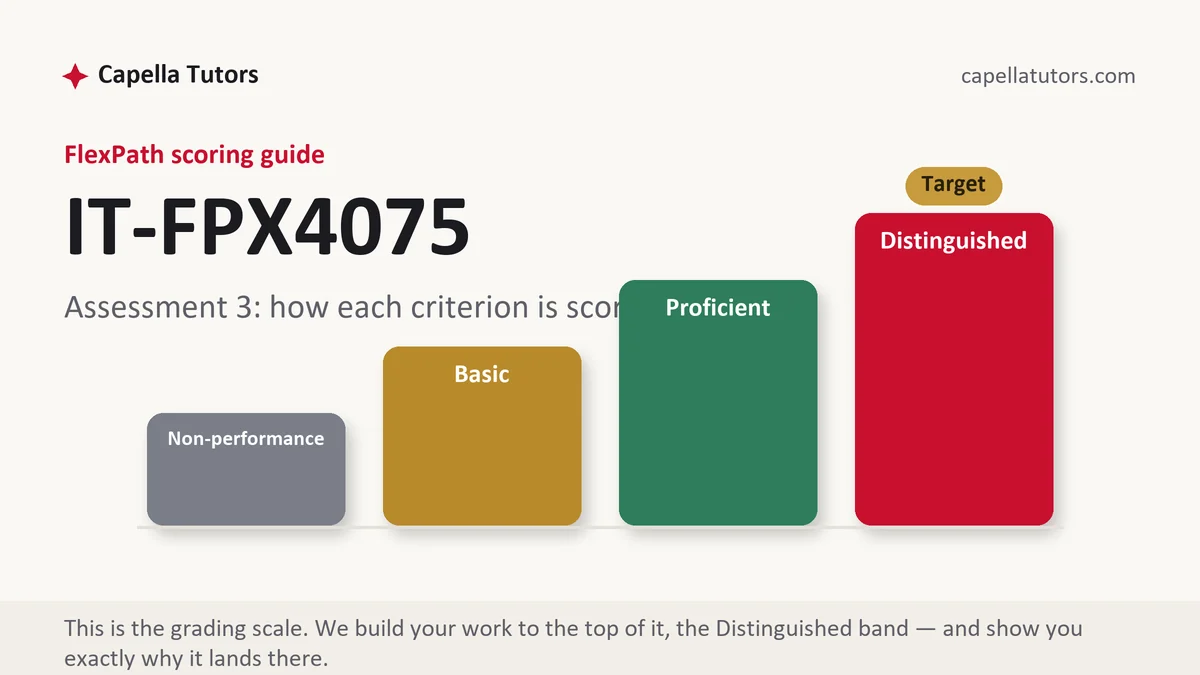
How IT FPX 4075 Assessment 3 is scored
Nothing in FlexPath converts to a percentage. Each criterion is placed at one of four levels by an evaluator reading against a guide, so treat the level descriptions as instructions:
| Level | What it means on an examination report |
|---|---|
| Distinguished | Limitations are disclosed before anyone asks for them, confidence is expressed on a scale the report defines, and the summary would be usable by a reader who skipped the technical sections. The extra move is written into each row; go and take it. |
| Proficient | The report is accurate, complete, and readable by a technical audience. Professional work that has not yet been written for the person who has to decide something. |
| Basic | Tool output arranged into headings, with conclusions that outrun what the evidence in the same section can carry. |
| Non-performance | A required element is missing, commonly the limitations or the plain-language summary. An absent section takes its row to the bottom regardless of the quality elsewhere. |
Write the report as though every line will be questioned by somebody whose job is to find the weak one. That habit is the difference between an examiner and a technician, and it is graded here more directly than anywhere else in the course.
The IT FPX 4075 Assessment 3 method, step by step
-
Decide who is reading, then write both versions
In a case where a community college is reviewing altered timesheet exports from a payroll clerk's workstation, the technical record is for another examiner and the summary is for a hearing panel of administrators. Draft the technical record first because it is the evidence, then write the summary from scratch rather than shortening what you already wrote. A compressed technical section is still a technical section.
-
Open with what was examined and what authorized it
The first page names the items, their identifiers, the digests that tie each image to its source, who requested the work, and the scope that request set. A reader who cannot tell from page one what you were allowed to look at has no way to judge anything that follows, and the criteria treat that opening as a required element rather than as courtesy.
-
Define your confidence scale before you use it
Say once, near the front, what you mean by supports, indicates, and is consistent with, then use those terms the same way for the rest of the document. Undefined confidence language slides around under pressure, and a report where the strength of a claim depends on which paragraph you are reading gives the top column away for nothing.
-
Disclose the limitations early and in numbers
If 214 of the drive's 500,118,192 sectors could not be read, say so, say where they sat, and say what conclusions they could have affected. Unreadable areas, an artifact class this platform version never wrote, an account you could not attribute to a person: each belongs in the report in your words, because every limitation you disclose is one that cannot be used against you later.
-
Write the summary for the decision maker last
Four things, in plain language: what was examined, what was found, what it means, and how confident you are. No tool names, no hex, no acronym without an expansion. Then hand it to somebody outside the field and ask what they would do next, because a summary that produces the wrong action is worse than one nobody reads.
-
Attack your own report, then self-score
Read the draft looking for the sentence a competent opponent would isolate: a conclusion about a person drawn from a record about a machine, an interval in the custody table, a time with no zone. Fix each one, then mark every criterion D, P, B, or N and revise anything you cannot honestly place at the top.
A structure that maps to the criteria
The targets below are how our tutors plan a report of this kind rather than a rule from Capella; a criterion asking for more detail in a section gets more words there.
| Section | What it must do | Guide |
|---|---|---|
| Summary for the decision maker | What was examined, what was found, what it means, and the confidence, in language with no technical terms in it. | ~250 words |
| Authorization and items examined | The requester, the scope, and each item with its identifier and the digests that connect image to source. | ~200 words |
| Method and tools | The sequence actually performed, tools with versions, and how the work could be reproduced by someone else. | ~250 words |
| Findings | Each finding with its location, the corroborating sources, and the confidence term from the defined scale. | ~350 words |
| Limitations | Unreadable areas quantified, attribution the evidence cannot support, and anything you chose not to examine. | ~200 words |
| Conclusion and sources | What the examination answered, what remains open, next steps, and procedural references in current APA. | ~200 words |
Annotated sample excerpt
A short piece of original model writing from our team, pitched at the level the guide rewards. Study the structure, then produce your own from your own case.
Two devices assigned to the payroll office were examined: a desktop computer, asset tag PC-2207, and the external drive kept in its docking station.1 Spreadsheet files matching the disputed timesheet exports were opened and saved on that desktop on nine occasions between 3 and 17 April, and copies of four of them were written to the external drive within minutes of each save, which the evidence supports at the level this report calls indicated.2 The examination cannot establish which person operated the computer during those sessions, because the account remained signed in across shifts and the office is shared, so any conclusion about who made the changes needs evidence from outside these devices.3
- 1Names the scope in one sentence with identifiers, so a panel member knows exactly what the report speaks to and what it is silent about.
- 2Gives the finding as dates and counts, then attaches a confidence term the report defined earlier. Precision plus a calibrated word beats a confident adjective every time.
- 3States the attribution limit unprompted and points the reader at the kind of evidence that would settle it. Volunteering the gap is what the top of the guide is describing.
The full premium sample for your exact assessment, written fresh to your scoring guide and issue, is free to request. Study it, revise it into your own voice, and submit work you understand.
The five mistakes that cost Distinguished
- One report doing both jobs. A technical record with the jargon thinned out serves neither audience and the summary criterion notices first.
- Confidence words used without a scale. If supports and indicates were never defined, an evaluator cannot tell whether your strongest claim is strong.
- Limitations discovered by the reader. An unreadable region or an unattributable account found by somebody else costs more than the same fact disclosed by you.
- Digests mentioned but not shown. A report that says integrity was verified without printing the values has asked for trust instead of supplying evidence.
- A conclusion naming a person. The devices recorded activity under an account, and the leap from account to individual needs evidence these devices never held.
Pre-submission checklist
- A plain-language summary appears before the technical sections and stands on its own
- Every item examined is listed with an identifier and its verification values
- Tools appear with versions, and the method could be repeated from the description
- The confidence scale is defined once and every finding uses a term from it
- Limitations are quantified, including anything unreadable or unattributable
- The draft has been read once as an opponent would read it, then self-scored row by row
Report due and the conclusions feel overstated?
Send the examination notes, the artifact list, and the criteria. A premium original arrives inside 24 to 48 hours with a summary a non-technical panel could act on, a technical record another examiner could repeat, and limitations written before anyone had to ask. The first sample is free.