This manual is for IT FPX 4075 Assessment 2, start to submission. The middle deliverable in Computer Forensics normally moves from handling evidence to reading it: you work on a copy of an image, recover artifacts, record where each one lived, and build a sequence of events that several independent records agree on. The criteria here are watching for restraint. An artifact records what a computer did, and a submission that quietly converts that into what a person intended has walked past its own evidence and loses the interpretation row doing it. Below is the method our tutors use for it, a structure that maps to the criteria, and an annotated sample excerpt. Prefer to hand it off? A premium original sample for this exact assessment comes back in 24 to 48 hours, revised free until it meets the guide. Capella's catalog lists the course as IT-FPX4075, and some courserooms print IT4075; both point to this same Assessment 2.
One honesty note before the manual: Capella revises courses and scoring guides over time, so always write to the exact scoring guide attached to your assessment in the courseroom. The course identity above is verified on capella.edu; the method and structure below are our tutors' approach to it, not Capella's official rubric text.
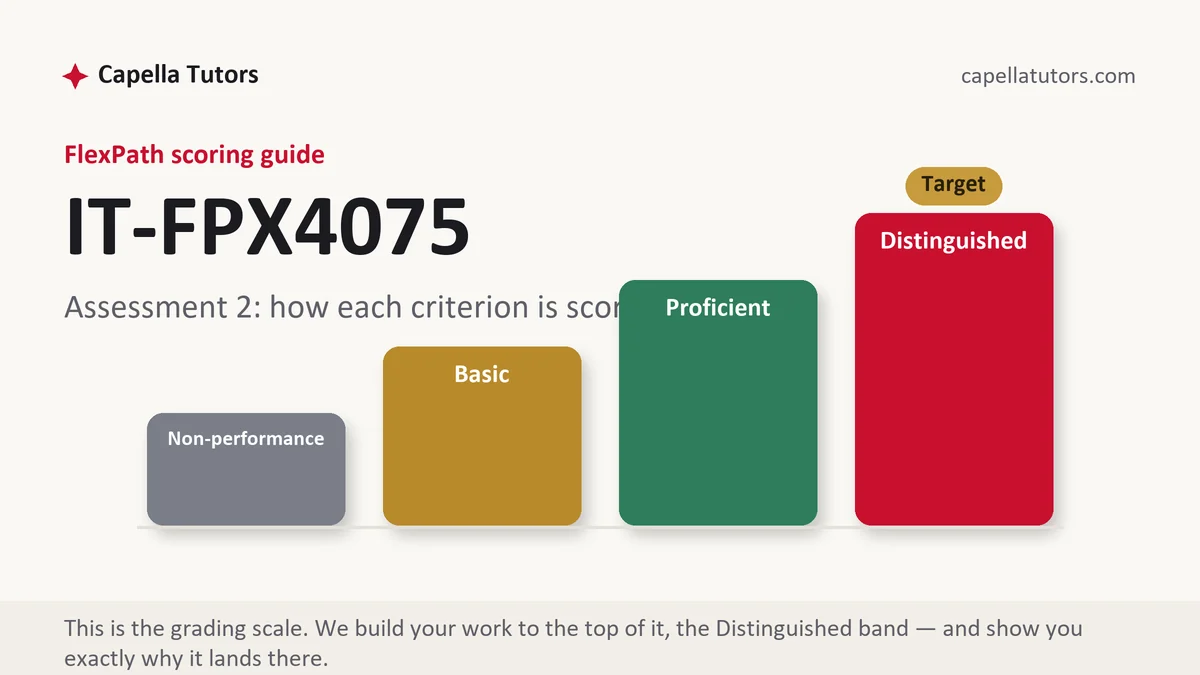
How IT FPX 4075 Assessment 2 is scored
There is no curve and no letter grade. Your evaluator reads each criterion row and places it at one of four levels, so the level language is what you should be drafting toward:
| Level | What it means on an artifact examination |
|---|---|
| Distinguished | Findings are corroborated across independent sources, every date carries a zone and an offset, and each interpretation says what it does not exclude. The extra move sits inside the criterion wording; go and find it. |
| Proficient | Artifacts are recovered accurately and reported completely. Correct work that stops one sentence before the reasoning an evaluator was hoping to read. |
| Basic | A dump of tool output with the interesting rows highlighted, which reads as a search rather than as an examination. |
| Non-performance | A required element is missing, most often the corroboration or the statement of limits. Absence, not weakness, is what drops a row to the floor. |
The pattern is worth learning here because it repeats everywhere later in the specialization. Whatever you assert, an evaluator is asking two questions behind it: how do you know, and what else could explain the same record. A submission that answers both without being asked has done the graded work.
The IT FPX 4075 Assessment 2 method, step by step
-
Turn the criteria into an examination plan before you open anything
Write the plan as a list of questions with the artifact class that would answer each one, then check that every criterion row appears somewhere in the list. Examinations drift because the examiner starts browsing, and a browsed image produces interesting screenshots and a shapeless paper. The plan is also your defense against searching where you had no reason to look.
-
Work on a copy, and say so in the document
In a case where a food distributor's warehouse terminal is suspected of running an unauthorized remote-access tool, the authorized image arrives verified and you analyze a working copy of it. Record how many copies exist, where they are held, and that the source image itself was never mounted for writing. Evaluators look for that sentence and it costs you nothing to write.
-
Search where the question points, not where the tool is fastest
The question in that case is whether the tool was installed under a named account or arrived bundled with a software package, so execution artifacts, service installation records, and installer logs matter and the personal photo folder does not. Say in the document which locations you examined and which you deliberately left alone, because a stated exclusion reads as discipline.
-
Give every artifact a location and a tool version
A finding that says a file was present is unusable; a finding that names the artifact, the path or the structure it was recovered from, the tool, and the tool version can be reproduced by a reader who has only your document. Behavior changes between releases, so a version-free claim about what an operating system records is a claim nobody can check.
-
Correct the clocks before you build the sequence
In our example the terminal ran 47 seconds behind the domain controller and was configured to a zone one hour off the site's local time, so every recorded event needs both corrections before it can sit beside a badge-reader record. State the offset, state the zone, and convert once to a single reference zone for the whole sequence rather than mixing them and hoping.
-
Write each finding in three sentences, then self-score
Sentence one is what was found and where. Sentence two is what that supports. Sentence three is what it does not exclude. Then mark every criterion row D, P, B, or N yourself, and rewrite any row where you cannot point at the sentence that earned the level.
A structure that maps to the criteria
These are the proportions our tutors plan an examination write-up around rather than limits Capella sets; a criterion that asks for more analysis gets more words.
| Section | What it must do | Guide |
|---|---|---|
| Scope and copy handling | What was examined, on which copy, under whose authority, and the questions the examination set out to answer. | ~150 words |
| Artifacts recovered | Each artifact with its location, the tool and version that read it, and the raw content or value in full. | ~300 words |
| Corroboration | Which independent sources support each material finding, and where a single source is all that exists. | ~250 words |
| Sequence of events | The reconstructed order with a stated reference zone, the clock offset applied, and gaps left visible. | ~300 words |
| Interpretation and confidence | What each finding supports, the alternative reading, and the confidence term attached under a defined scale. | ~300 words |
| Limitations and sources | Unreadable areas, artifact classes absent from this platform version, and procedural references in current APA. | ~150 words |
Annotated sample excerpt
One paragraph of original model text, at the register the top column describes. Read it for the moves rather than the facts, then build the same shape from your own case.
The application compatibility cache on the working copy contains an entry for a binary named ra-helper.exe in a per-user temporary directory, parsed with a current release of an open forensic suite at version 3.4.1 and recorded with the raw value in Appendix B.1 A shortcut file in the same profile, a run key entry in that user's registry hive, and a service installation record in the system event log all reference the identical path inside a nine-minute window, which is three sources that were written by different mechanisms rather than one record read three ways.2 The evidence supports execution of that binary under that profile at 22:41 UTC on 4 February, and it does not establish who was seated at the terminal, since the profile had been signed in continuously since the previous shift change.3
- 1Locates the artifact precisely and names the parser version, which is what lets a reader with only your document reproduce the finding on their own copy.
- 2Corroboration is claimed as a count of mechanisms, not a count of rows. Three views of one write are still one source, and an evaluator will check which you have.
- 3Observation, inference, and limit in that order, in separate sentences. Volunteering what the evidence cannot settle is the move the Distinguished column is written to pay for.
The full premium sample for your exact assessment, written fresh to your scoring guide and issue, is free to request. Study it, revise it into your own voice, and submit work you understand.
The five mistakes that cost Distinguished
- Analysis run against the image rather than a copy of it. Work that touched the evidence set is finished before anyone reads the findings.
- A finding with no location. An artifact nobody can go and look at again is an assertion wearing forensic clothing.
- A sequence built on one source. A single log read three ways fills rows without adding any corroboration to them.
- Offsets and zones left out. Times that cannot be lined up against a door log or a server log are unusable the moment the case leaves the machine.
- Intent read off an artifact. The system recorded an action, and which human chose it is a question the record was never able to answer.
Pre-submission checklist
- The document states which copy was examined and how many copies exist
- Every artifact carries a location, a tool name, and a tool version
- At least two independently written sources support each material finding
- Clock offset and time zone are stated once and applied across the whole sequence
- Each finding separates observation, inference, and what is not excluded
- The confidence scale is defined on the first page and used the same way throughout
Examination due and the artifacts are not lining up?
Send the image description, the artifact exports your faculty supplied, and the criteria. A premium original returns inside 24 to 48 hours with locations, tool versions, a corrected sequence, and interpretations that stop where the evidence does. First one is free.