This manual is for IT FPX 2249 Assessment 3, start to submission. Assessment 3 of IT FPX 2249 usually asks the program to survive its users: input that arrives wrong, exceptions caught where they are thrown, and a test table that proves the behaviour rather than asserting it. The criteria are graded individually against your scoring guide, and most submissions skip the testing because the program appeared to work once. Below is the way our tutors work it, a structure organised around the criteria, and an annotated sample excerpt. Would you rather delegate it? A premium original sample for this exact assessment is delivered in 24 to 48 hours, revised without charge until the guide clears. Capella's catalog lists the course as IT-FPX2249, and some courserooms print IT2249; both point to this same Assessment 3.
One honesty note before the manual: Capella revises courses and scoring guides over time, so always write to the exact scoring guide attached to your assessment in the courseroom. The course identity above is verified on capella.edu; the method and structure below are our tutors' approach to it, not Capella's official rubric text.
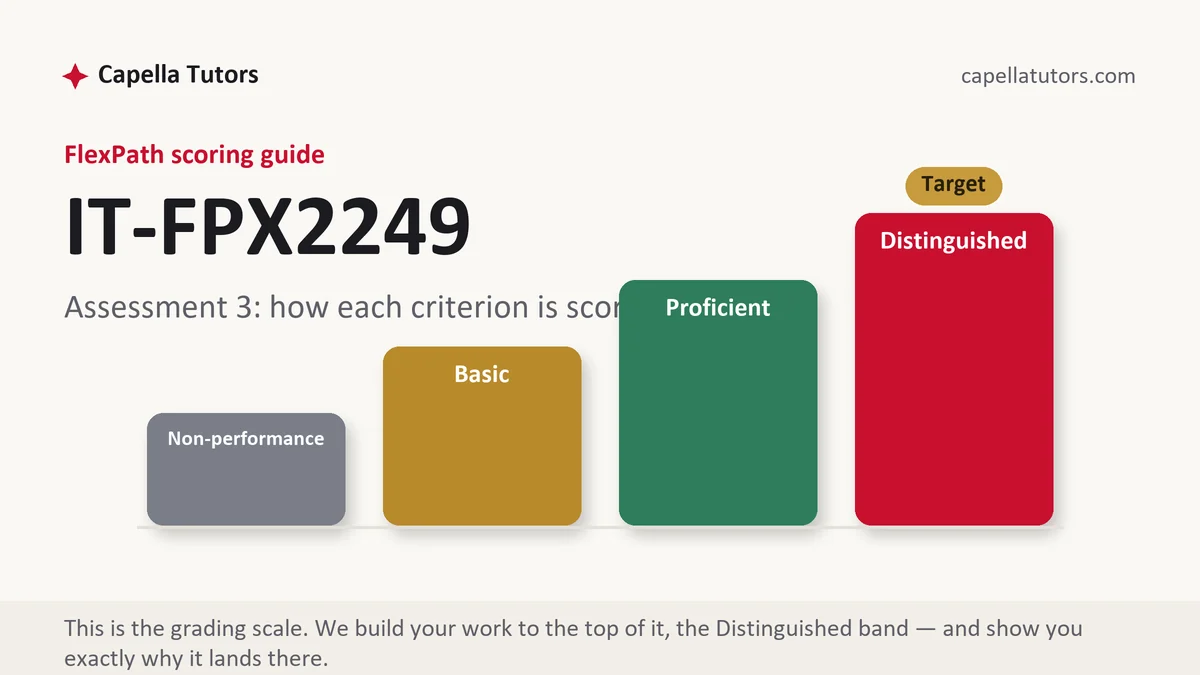
How IT FPX 2249 Assessment 3 is scored
Levels, four per criterion, no marks out of ten. The descriptions are the closest thing to instructions you will be handed:
| Level | What it means on a robustness and testing deliverable |
|---|---|
| Distinguished | The handling sits around the operation that throws, every message tells the user what to do next, the test table records a failure and the fix that followed it, and the document names the inputs still untested. That last line is where the top level sits. |
| Proficient | Input validated, exceptions handled sensibly, and a complete test table supplied. Reliable work, one disclosure below the column above. |
| Basic | A program that works when used correctly, with a try block wrapped around everything and one screenshot of a good run. The usual result on a first robustness deliverable. |
| Non-performance | A required artifact never appears, most often the test evidence. A criterion written about testing cannot be satisfied by a program that happens to be robust. |
Silence inside a catch block does more damage than no catch block at all, since it turns a visible crash into an answer that is merely wrong. Checked exceptions force the compiler to make you deal with them and unchecked ones do not, and both deserve a sentence in your write-up.
The IT FPX 2249 Assessment 3 method, step by step
-
Decide what counts as bad input before you write the reader
List the ways the value can arrive wrong: the wrong type, an empty entry, a number outside the legal range, a format the user believes is reasonable. Each of those gets a defined response. Deciding this first is what produces a validation loop rather than a program that crashes and a paragraph explaining that users should be careful.
-
Wrap the operation that throws, not the whole program
A console reader throws when it is handed text where it expected a number, so the try block belongs around the parse itself. A block around the entire program suppresses errors instead of handling them, loses whatever the user already entered, and cannot re-prompt. The narrowness of the block is the thing the criterion is measuring.
-
Write messages a user could act on
An exception message aimed at the developer is not a handled error from the user's point of view. Name the expected format and re-prompt, keep the entries already collected, and never let the catch block sit silent. Then say in your write-up which exceptions are checked, which are unchecked, and why each is caught where it is.
-
Build the test table before you write the explanation
Four columns: the input, what you expected, what happened, and whether that counts as a pass. Fill it before drafting a word of prose. Choose the rows deliberately, including a normal case, a boundary case, an empty case, a wrong type, and a value outside the legal range. The empty case is usually the interesting one because it reveals whether the program checks its own preconditions.
-
Keep the failing row and the fix
A row that failed is not embarrassing, it is the evidence. Capture the failing run, describe what you changed, capture the passing run, and leave both in the document. That pair demonstrates the debugging reasoning the higher criteria describe far better than a table of green ticks nobody watched being earned.
-
Name the untested inputs, then self-score
Say which cases you did not exercise and what you are therefore taking on trust. Where your section introduces a testing framework, a handful of assertions over the same cases is worth writing even when the guide only encourages it. Then grade each criterion yourself and submit with evaluation time in hand.
A structure that maps to the criteria
Targets our tutors plan a robustness deliverable of this size against, not limits set by Capella; grow whichever section your guide leans on.
| Section | What it must do | Guide |
|---|---|---|
| Input contract | What the program accepts, what it refuses, and what it does after refusing. | ~200 words |
| Validation and handling | Where each try block sits, what it catches, and why it sits there rather than higher up. | ~250 words |
| Messages and recovery | What the user is told, and what state survives a rejected entry. | ~180 words |
| The test table | Input, expected result, actual result and verdict, one row per deliberate case. | ~300 words |
| A failure and its fix | The failing run, the change made, and the passing run, all captured. | ~200 words |
| Untested cases and references | The inputs left unexercised, plus API documentation for your release in current APA. | as needed |
Annotated sample excerpt
A short passage from an original model our team produced, showing how validation and testing are argued together. Learn the pattern and rebuild it around your own program.
Volunteers type lap times at the poolside on a phone, so the entry is the least trustworthy part of the program and the validation loop is where most of the rows are won.1 The read sits inside a try block wrapped around the parse itself rather than around the program, so a volunteer who types one minute nine instead of 1:09 is re-prompted with a message naming the expected format, and every time already entered survives.2 The test table carries five deliberate rows, a normal time, a single entry, no entries at all, the words one minute nine, and a negative number, and the empty case is the interesting one, because the average would divide by zero and the run in Figure 4 shows the program reporting no times recorded instead of throwing.3
- 1Names the real source of bad input and says where the marks are before describing any code. The criterion is about robustness, and robustness is easiest to argue from the user backwards.
- 2States the placement of the try block and the consequence of that placement in the same sentence. Keeping earlier entries is the detail that distinguishes handling an error from surviving one.
- 3Lists the test rows and then explains why one of them matters most. Showing the precondition check instead of the exception is the evidence the higher levels describe.
The full premium sample for your exact assessment, written fresh to your scoring guide and issue, is free to request. Study it, revise it into your own voice, and submit work you understand.
The five mistakes that cost Distinguished
- One try block wrapped around the entire program. It suppresses rather than handles, loses the entries already collected, and cannot re-prompt the user at all.
- A catch block that swallows the exception without a word. The crash becomes a silently wrong result, which is the worse of the two outcomes and is scored that way.
- A test table with no failing row anywhere in it. Either the cases were chosen to pass or the failures were quietly removed, and both readings cost the testing criterion.
- Error messages written for the developer. A stack trace tells the user nothing they can act on, and the row is graded from the user's side of the screen.
- An array loop written with a less-than-or-equal comparison. Indexes run to length minus one, so the final pass throws, and the fault survives testing whenever the array is never quite full.
Pre-submission checklist
- Every category of bad input listed with the response it receives
- Try blocks placed around the operation that throws, not around the program
- Messages name the expected format, and prior entries survive a rejection
- Test table complete with input, expected, actual and verdict for each case
- One failing run and its corrected run both captured in the document
- The untested inputs named, with the release and development kit version stated
Validation and testing due?
Send the prompt, the criteria and the release you build against. The sample comes back in 24 to 48 hours with the validation loop in place, handling around the operation that throws, and a test table covering the valid, boundary and invalid cases. Every case is executed by a developer before delivery, and revisions are free until the guide is met.