This manual is for IT FPX 2180 Assessment 2, start to submission. Assessment 2 of IT FPX 2180 normally asks you to stand a working environment up rather than adjust one: a host, a hypervisor, one or more guest operating systems, and a document that lets a reader rebuild what you built. Your scoring guide sets the exact requirements, and the rows that cost marks are about reproducibility, since a procedure with no version numbers cannot be repeated by anyone. The approach our tutors take is below, with a structure assembled from the criteria and an annotated sample excerpt. Prefer to hand it off? A premium original sample for this exact assessment lands in 24 to 48 hours with free revisions until the criteria clear. Capella's catalog lists the course as IT-FPX2180, and some courserooms print IT2180; both point to this same Assessment 2.
One honesty note before the manual: Capella revises courses and scoring guides over time, so always write to the exact scoring guide attached to your assessment in the courseroom. The course identity above is verified on capella.edu; the method and structure below are our tutors' approach to it, not Capella's official rubric text.
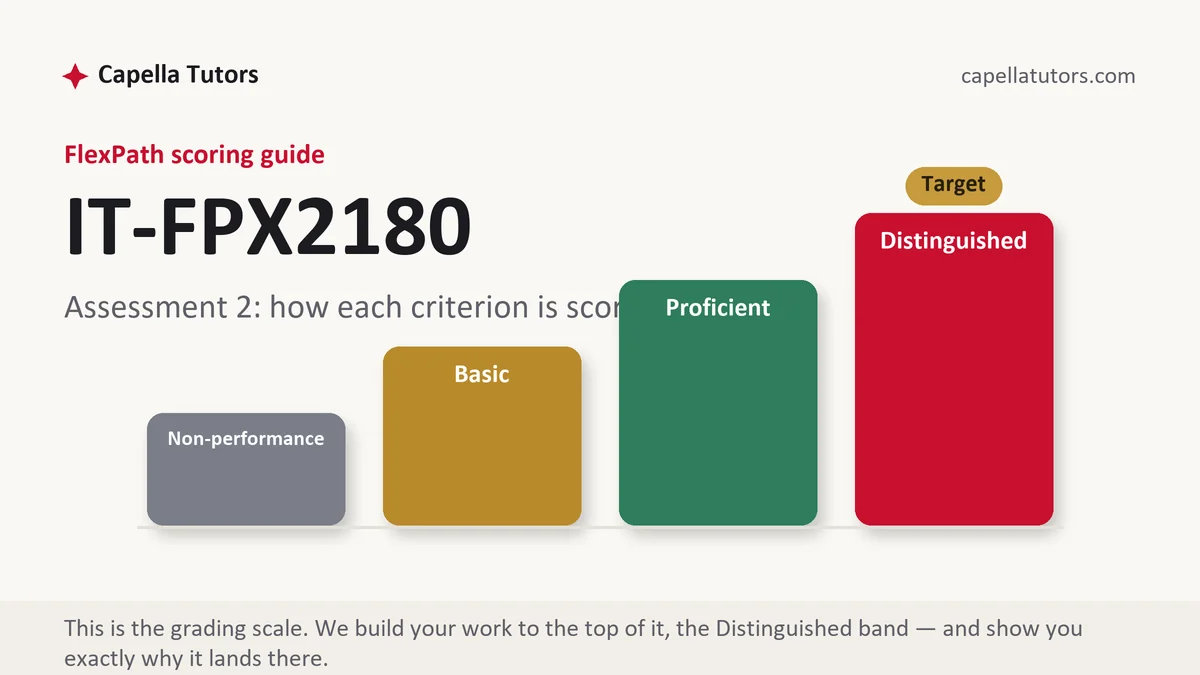
How IT FPX 2180 Assessment 2 is scored
No percentages are involved. Each criterion is placed at one of four levels, and reading the levels as build instructions is the entire technique:
| Level | What it means on a build and configuration deliverable |
|---|---|
| Distinguished | Versions and allocations are stated, every configuration step is text a reader could retype, the checks are re-run after a restart, and the document says which decisions the next person should revisit. Naming the decisions that are arguable is where the top level sits. |
| Proficient | The environment is built correctly, documented in order, and evidenced. Reproducible work, one deliberate move below the top column. |
| Basic | A narrative of a successful install with screenshots, no versions, no allocations, and nothing a reader could repeat. Where most first build documents land. |
| Non-performance | A required element never appears, commonly the environment specification or the post-restart verification. Absent is scored as absent. |
Two words carry most of the marks in a build deliverable, and they are reproducible and persistent. A configuration that works until the guest reboots has not been configured, and a procedure without a release number cannot be checked, which is why the documentation criterion reads like an audit requirement.
The IT FPX 2180 Assessment 2 method, step by step
-
Write the environment specification before you install anything
Host machine, hypervisor and its exact version, guest operating systems and their builds, memory and disk assigned to each, and the network mode you put them in. That paragraph makes every later command reproducible, and it is the cheapest row on the guide to secure because you can write it before the first installer finishes.
-
Choose type 1 or type 2 deliberately and say why
A hypervisor running directly on the hardware and one running as an application on top of an existing operating system are different products with different consequences for performance and for what else can run on the box. Almost every learner uses the second kind on a laptop they already own. State that plainly, with the reason, rather than leaving the reader to infer it.
-
Keep the guests off the production network unless the task needs it
An internal or host-only network is the responsible default for lab work, and saying so in the document is a security sentence that costs one line. Where an exercise genuinely needs outbound access, say what it needed it for and note that the guest was patched before it got there.
-
Snapshot at the clean state, before any role is added
Take the snapshot the moment the guest is installed, updated and named, and record what you called it. Then work forward. A snapshot is a rollback convenience rather than an archive, and writing that distinction into the document earns a line in the risk row while saving you a rebuild when a later step goes sideways.
-
Prove persistence, not just presence
Restart every guest and run the checks again: hostname, address, time source, service state. Put both runs in the document. A capture taken thirty seconds after a change proves a state existed on a screen, and the criterion is asking whether the configuration survives the machine being turned off, which is a different claim entirely.
-
Say what you would change next time, then self-score
Two or three sentences naming the allocations you would revisit, the step that took longest, and the decision a reader might reasonably make differently. It reads as engineering judgment rather than as hedging. Then grade yourself criterion by criterion and submit with the two business days of evaluation still ahead of you.
A structure that maps to the criteria
Planning lengths our tutors work to on a build document of this size rather than requirements from Capella; stretch the sections your guide weights.
| Section | What it must do | Guide |
|---|---|---|
| Purpose and environment | What the environment is for, plus host, hypervisor, guest builds, memory, disk and network mode. | ~200 words |
| Installation sequence | The steps in the order performed, as text a reader could retype rather than only as images. | ~300 words |
| Configuration applied | Naming, addressing, time source, updates and any role added, each with its parameter explained. | ~250 words |
| Verification after restart | The same checks run before and after a reboot, with both results shown. | ~200 words |
| Snapshots and rollback | What was captured, when, under what name, and what the snapshot does not protect you from. | ~150 words |
| Decisions to revisit and references | Allocations and choices a reader might make differently, plus vendor documentation in current APA. | as needed |
Annotated sample excerpt
An original excerpt from our team, showing how a build reads when the specification arrives before the screenshots. Take the pattern into your own environment.
The baseline is built once and cloned for a teaching lab, so every decision inside it is one that forty students inherit unchanged.1 The host is a staff laptop running a type 2 hypervisor, with the exact build recorded in section 2, carrying two guests: a server operating system given 4 GB of memory and a 40 GB virtual disk, and a Linux distribution given 2 GB and 20 GB, both attached to an internal network so neither can reach the campus network while exercises are running.2 A snapshot named baseline-clean was taken once both guests were installed, updated and renamed but before any role was added, and the checks in Figure 5 were run again after a full restart to show that the hostname, the static address and the time source all survived the reboot rather than only the session.3
- 1Gives the purpose in a sentence that also explains why the documentation has to be exact. A baseline forty people inherit is a real reason for the reproducibility the criterion demands.
- 2Every number a reader would need to rebuild this appears in one place, and the network choice is stated with its consequence. That is the environment row satisfied in a single sentence.
- 3Distinguishes the clean snapshot from a later one and proves persistence across a restart. Showing the second run is what turns a screenshot into verification.
The full premium sample for your exact assessment, written fresh to your scoring guide and issue, is free to request. Study it, revise it into your own voice, and submit work you understand.
The five mistakes that cost Distinguished
- No versions or build numbers anywhere in the document. A procedure without them cannot be reproduced, and reproducibility is precisely what the documentation row measures.
- Commands supplied only as pictures. A reader cannot retype an image, and the criterion asks for steps somebody else could follow rather than admire.
- Verification captured only in the same session as the change. Persistence is a separate claim, and an unrestarted guest has not demonstrated it.
- A snapshot presented as the backup strategy. It rolls one machine back to one moment on the same storage, so calling it an archive costs the risk row.
- Memory and disk allocations left unstated. The reader cannot judge whether the guest was sized for the task, and sizing is usually one of the explanation criteria.
Pre-submission checklist
- Host, hypervisor version, guest builds, memory, disk and network mode all stated
- Every step given as text a reader could retype, images used as exhibits only
- Hypervisor type named with the reason it was chosen
- Clean snapshot recorded by name, with what it does not protect against
- Checks run before and after a restart, with both results in the document
- Two or three decisions named that a later reader should reconsider
Build or install deliverable due?
Tell us the platform your section uses and the environment you can actually run. The sample arrives inside 24 to 48 hours with the specification written first, each step as repeatable text, and the post-restart checks included. Version numbers get checked too, since a procedure written for one release and captured on another is spotted in seconds.