This manual is for IT FPX 2180 Assessment 1, start to submission. Assessment 1 of IT FPX 2180, Operating System and Hardware Infrastructure, is usually the course's first lab deliverable: an access requirement turned into a configuration, the configuration proved with output rather than asserted, and the mechanism explained in prose no capture can substitute for. FlexPath grades it criterion by criterion against your scoring guide, and the doing half and the explaining half are scored separately, which is why correct work described badly lands in the same column as good writing about work never performed. What comes next is our tutors' working method, a structure taken row by row from the criteria, and an annotated sample excerpt. Want it handled? Inside 24 to 48 hours you receive a premium original sample for this exact assessment, revised without charge until the guide is met. Capella's catalog lists the course as IT-FPX2180, and some courserooms print IT2180; both point to this same Assessment 1.
One honesty note before the manual: Capella revises courses and scoring guides over time, so always write to the exact scoring guide attached to your assessment in the courseroom. The course identity above is verified on capella.edu; the method and structure below are our tutors' approach to it, not Capella's official rubric text.
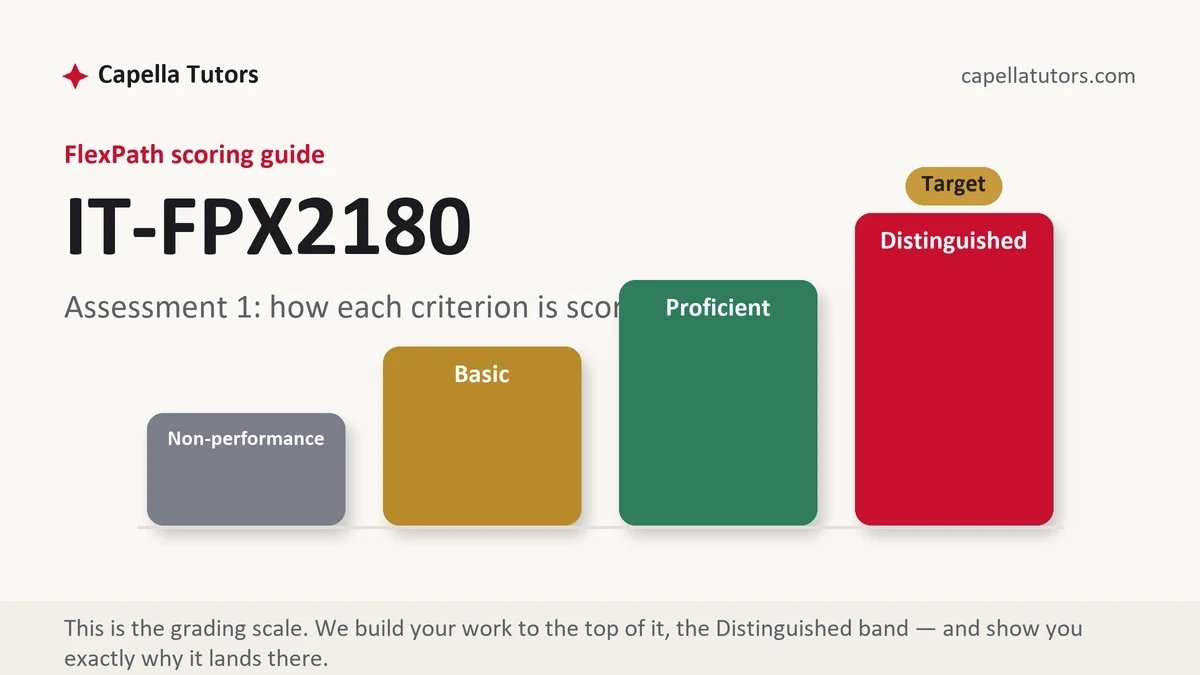
How IT FPX 2180 Assessment 1 is scored
FlexPath hands out levels rather than letters. Each criterion lands on one of four, and the level wording is the specification for the paragraph under it:
| Level | What it means on a permissions and access deliverable |
|---|---|
| Distinguished | The requirement is restated as a rule, the mode or access entry is shown and explained digit by digit, the check and the change appear in the same evidence, and the paper says what a user outside the permitted group actually sees. That last detail is usually where the top level hides. |
| Proficient | The configuration is correct, verified and explained clearly. Competent lab work, one specific observation short of the column above. |
| Basic | Access described in words with no mode, no access entry and no listing, so the reader has to take it on trust. The commonest result on a first permissions deliverable. |
| Non-performance | A required artifact is absent, most often the verification output. A criterion with nothing to read against it is scored as empty rather than as weak. |
Permissions carry more criteria in this course than any other topic, so the vocabulary is worth getting exact early. Read is four, write is two, execute is one, and on a directory that execute bit is the right to enter rather than the right to run, which is the single fact that repairs most unreachable folders.
The IT FPX 2180 Assessment 1 method, step by step
-
Read the guide for its verbs, then build the environment once
Install, configure, verify, document and justify are five different artifacts and usually five different rows. Sort them before you touch a machine, then build the environment a single time and work the list in order, because rebuilding a guest halfway through a document costs more hours than planning the sequence ever does.
-
Turn the access requirement into a written rule first
Before any command, write the rule in one sentence a non-technical reader would confirm: who must reach this, who must not, and what each side may do once they are in. Every later configuration choice is then justified by that sentence, and the justification criterion has something to point at instead of your preference.
-
Confirm the change is authorised, then take a rollback point
On any machine that is not purely yours, get the change agreed and say in the document who agreed to it and what window you were given. Snapshot the guest or export the existing access entries before you alter anything. A named rollback path is frequently its own criterion, and it costs one command to earn.
-
Apply it least-privilege, and show the mode
Grant the narrowest access that satisfies the rule, then put the evidence in the document as text. On Linux that means the octal mode and the group owner in a long listing; on Windows it means the access entries with inheritance visible, remembering that an explicit deny beats an allow at the same level. Words about access satisfy nothing the criterion asked for.
-
Verify from the other side of the fence
Proving the permitted user can get in is half a test. Sign in as an account that should be refused and capture what it actually receives, because a permission denied message and an empty directory look identical to a manager and mean different things to an evaluator. Re-run the check after a restart wherever persistence is part of the requirement.
-
Explain the mechanism, name the other platform, self-score
Write how the control actually works as a sequence, then give the equivalent on the operating system you did not use, since a cross-platform sentence is often its own row and costs almost nothing once the work is done. Then grade each criterion yourself and upload early, allowing two business days for the evaluation.
A structure that maps to the criteria
The word targets are planning figures our tutors use for a lab document of this size, not Capella rules; expand whichever section your own guide leans on hardest.
| Section | What it must do | Guide |
|---|---|---|
| Requirement and environment | The access rule in one sentence, plus the host, hypervisor and guest versions you worked on. | ~180 words |
| The configuration applied | The commands or interface steps in the order performed, given as text with the parameters explained. | ~280 words |
| Verification evidence | Output proving the change took effect, with change and check visible in the same figure. | ~200 words |
| The refusal case | What an account outside the permitted group receives when it tries, captured rather than described. | ~150 words |
| Mechanism and platform equivalent | How the control works as a sequence, and the equivalent on the other operating system. | ~250 words |
| Risk, rollback and references | What the change could break, how it would be undone, and vendor documentation in current APA. | as needed |
Annotated sample excerpt
A passage from an original model our team produced, at the register the top column describes. Learn the moves in it, then write the same shape around your own environment.
The two workstations on the shop floor run the toolpath software and are used by whoever is on shift, which until this change meant six machinists signing into one shared account that held local administrator rights.1 With the supervisor's written authorisation and a snapshot taken first, each machinist received an individual standard account, and the shared drawings directory was set to mode 750 with the machinists group as its group owner: the owner keeps read, write and the traverse bit, the group keeps read and traverse, and everyone else gets nothing.2 Figure 2 shows the long listing with that mode and group beside the directory name, and Figure 3 shows a shift account outside the group receiving a permission denied message rather than an empty folder, which is the distinction worth capturing.3
- 1Establishes the requirement as a fact about people rather than as a technical preference. Six users on one privileged account is the problem statement, and it justifies everything that follows.
- 2Names the authorisation and the rollback point, then spells the mode out digit by digit. Explaining what each digit grants is the move that satisfies the configuration and explanation rows at once.
- 3Captures the refusal as well as the success, and says why the wording of the refusal matters. Testing from the excluded side is the evidence most submissions never produce.
The full premium sample for your exact assessment, written fresh to your scoring guide and issue, is free to request. Study it, revise it into your own voice, and submit work you understand.
The five mistakes that cost Distinguished
- Access described in prose with no mode or entry shown. The row asks what was granted to whom, and only the octal mode or the access control entry answers that question.
- A directory left without its traverse bit. Members cannot enter it however readable the files inside are, and the configuration fails a test the evaluator will run.
- Only the successful sign-in captured. Half a test proves half a control, and the refusal case is where the permissions actually demonstrate themselves.
- Every command in the transcript run with elevated rights. The screenshot contradicts the paragraph about least privilege, and the prompt is read before the prose.
- No rollback recorded anywhere in the document. A change with no stated way back reads as untested, and the risk row is written about exactly that omission.
Pre-submission checklist
- The access rule written in one sentence before any configuration appears
- Authorisation for the change and a snapshot or export both recorded
- Octal mode or access entries shown as text, with each grant explained
- A refusal captured from an account that should not have access
- Checks re-run after a restart wherever persistence is required
- Host, hypervisor and guest versions stated so the work is reproducible
Permissions lab due?
Send the prompt, the criteria and the platform your section uses. The sample comes back inside 24 to 48 hours with commands as repeatable text, each followed by the check that proves it took, plus the refusal case captured. A technical reviewer re-runs every command before the file leaves, and revisions stay free until the guide clears.