This manual is for IT FPX 1170 Assessment 3, start to submission. Assessment 3 of IT FPX 1170 usually turns to the goals half of the course title: a target role described by the work it involves, a skills gap named honestly, a credential path with a sequence and a reason, and dates a calendar could actually hold. The criteria are graded individually against your guide, and the ones that catch people are about checkability rather than about ambition. The method our tutors follow is set out below, alongside a criterion-shaped structure and an annotated sample excerpt. Would you rather hand it over? A premium original sample for this exact assessment arrives in 24 to 48 hours, revised free until the criteria are satisfied. Capella's catalog lists the course as IT-FPX1170, and some courserooms print IT1170; both point to this same Assessment 3.
One honesty note before the manual: Capella revises courses and scoring guides over time, so always write to the exact scoring guide attached to your assessment in the courseroom. The course identity above is verified on capella.edu; the method and structure below are our tutors' approach to it, not Capella's official rubric text.
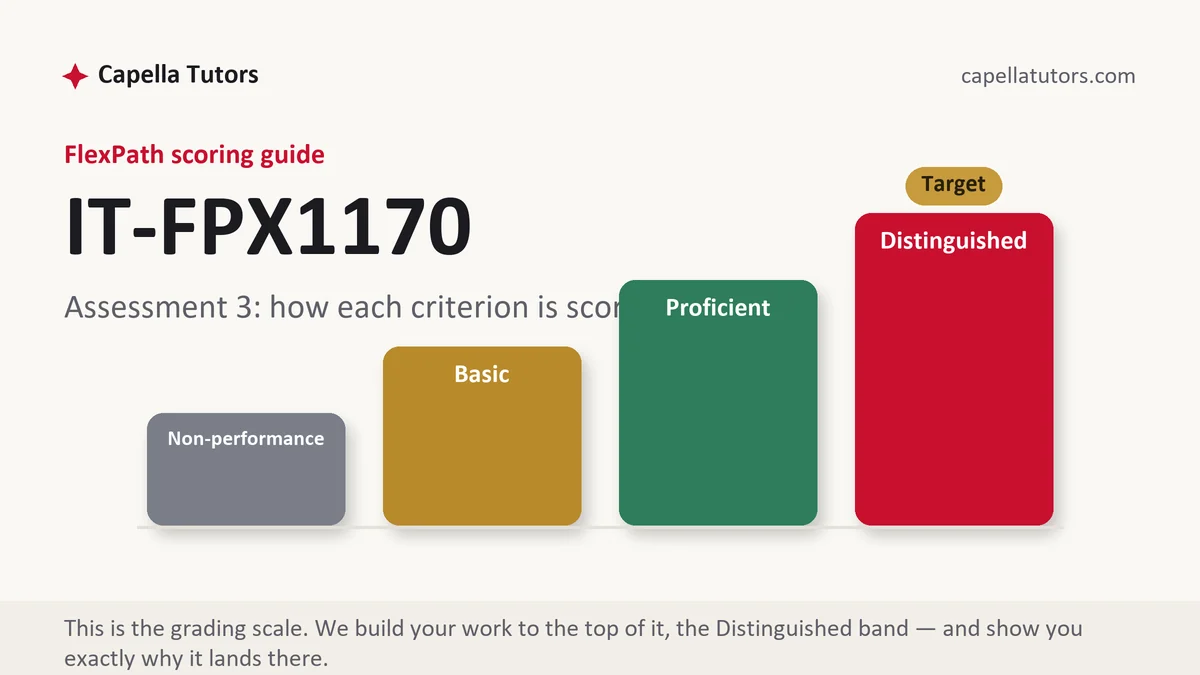
How IT FPX 1170 Assessment 3 is scored
Criteria in FlexPath land on levels, not on marks out of ten, and the four descriptions are the clearest instructions you will get:
| Level | What it means on a professional goal plan |
|---|---|
| Distinguished | The target is described by the work rather than by the title, the gap is measured against something external, every figure is traceable to the body that published it, and the plan says what happens if a date slips. The fallback is the sentence most plans omit. |
| Proficient | A complete plan with dates, costs and a credential sequence that makes sense. Genuinely usable, and one contingency short of the top. |
| Basic | A statement of intent with a credential named and a rough timescale attached. Sincere, unfalsifiable, and the commonest result on a first plan. |
| Non-performance | A required component is simply absent, most often the renewal obligation or the cost. The row is graded on what is written, not on what was intended. |
The discipline that raises every row at once is treating your own development like a small procurement: somebody else has to be able to check your reasoning. Once the plan is written for a sceptical reader, the criteria about evidence and feasibility stop being separate work.
The IT FPX 1170 Assessment 3 method, step by step
-
Describe the target role by its work, not its label
Two employers use the same job title for different jobs, so a title alone tells an evaluator nothing. Write what the person in that seat actually does across a week, which systems they touch, and what they are accountable for. Pull that description from real advertisements rather than from imagination, and say where you pulled it from.
-
Measure the gap against something outside yourself
A paragraph asserting that you are strong in networking and weaker in scripting is a self-report, and self-reports sit at the bottom of the evidence order. Score yourself against a published competency list or against the requirements repeated across the advertisements you collected, and the self-assessment row stops being an opinion piece.
-
Sequence the credentials and say why that order
Vendor-neutral credentials test concepts that travel between employers, vendor-specific ones certify you on a named platform, and a plan that mixes them should explain the mix. Some sit under others by design and some gate on documented work experience rather than on study. State the structure of each one you pick, taken from its current candidate handbook.
-
Cost it across the validity period, not on the day
An exam fee is the smallest part. Add study material, one practice attempt, the hours you will not be earning, and the renewal obligation that arrives on a cycle and is met with continuing education or a further exam. Quote the figures from the certifying body's current page and say when you looked, because those pages change without notice.
-
Put the schedule on a real calendar
Study commitment in hours per week rather than in months, a target sitting date on an actual date, and milestones between now and then. Then add the sentence most plans leave out, which is what you do if the date slips. A plan with a stated fallback reads as planning; one that assumes nothing goes wrong reads as optimism.
-
Define success beyond the pass, then self-score
Say what the credential is supposed to change: an interview obtained, a responsibility added, an internal move applied for, each with a date. A development plan with no measure of success is a study schedule with a longer title. Grade every criterion yourself before uploading, and leave two business days for the evaluation.
A structure that maps to the criteria
These are the lengths our tutors plan a goal document of this size to, not limits Capella sets; lengthen whichever section your own guide weights heaviest.
| Section | What it must do | Guide |
|---|---|---|
| Where you are now | Current role, responsibilities and experience, described plainly and without inflation. | ~180 words |
| The target role | What the work involves, taken from real requirement language rather than from a title. | ~220 words |
| The gap, measured | Your skills scored against an external list, with the weak areas named rather than softened. | ~250 words |
| Credential path | The credentials chosen, their structure and prerequisites, and the reason for the order. | ~250 words |
| Schedule and budget | Hours per week, milestone dates, fees, materials, renewal cycle, and the fallback if a date moves. | ~250 words |
| Measures and references | What success looks like beyond the pass, plus current APA in both directions. | as needed |
Annotated sample excerpt
A section from an original model our team wrote, showing the level of specificity the top column expects. Borrow the shape and fill it with your own situation.
Present role is tier one support, two years in, closing account and printer tickets with the occasional supervised server restart; the target is a junior systems administrator seat with the same employer inside eighteen months.1 Scored against the published objectives for the two credentials under consideration, the gap comes to three items, which are domain administration, shell scripting, and backup and recovery, and the second appears in neither set of objectives, so it goes on the plan as coursework rather than as an exam.2 The first attempt is set for the second week of March at the fee published on the certifying body's current page, checked on 3 February, with study at six hours a week for fourteen weeks and one spare retake window left in front of the date in case the first sitting misses.3
- 1States the starting point without inflating it. Naming the supervised part of the current job is the kind of accuracy that makes the rest of the plan credible to a sceptical reader.
- 2Measures the gap against published objectives instead of against a feeling, then handles the item no credential covers. Noticing that one gap needs a different instrument is the analysis the row rewards.
- 3Puts a fee, a retrieval date, a weekly commitment and a spare retake window in one sentence. Every clause here is checkable, which is the whole point of the criterion.
The full premium sample for your exact assessment, written fresh to your scoring guide and issue, is free to request. Study it, revise it into your own voice, and submit work you understand.
The five mistakes that cost Distinguished
- A target described only by its job title. Two employers mean different things by the same words, so a title on its own gives an evaluator nothing to assess the plan against.
- A gap analysis built entirely from self-report. Unmeasured confidence is the weakest evidence available, and the row explicitly asks what you scored yourself against.
- A credential described from its reputation. Writing about an exam without opening its current objectives shows exactly that, since the domains rarely match what the internet says they are.
- Renewal left out of the budget. A credential you cannot maintain is a recurring cost you have not counted, and the cost row is written to catch the omission.
- Milestones expressed as soon and next year. The schedule is the artifact being graded, and a schedule without dates is a paragraph about intentions.
Pre-submission checklist
- Target role described by its actual work, sourced from real requirement language
- Skills gap scored against a published competency list or a collected requirement set
- Credential structure and prerequisites taken from the current candidate handbook
- Fees, materials and renewal obligations quoted with the date you checked them
- A dated schedule in hours per week, with a stated fallback if a date slips
- Success defined beyond passing, with a date attached to each measure
Goal plan due and nothing written?
Tell us the role you are aiming at, the criteria, and how many study hours a week are realistic. The sample comes back in 24 to 48 hours with the gap measured against published objectives, the schedule fitted to the weeks you have, and every fee traceable to the body that published it. Free revisions until the guide is met.