This manual is for IT FPX 1170 Assessment 2, start to submission. Assessment 2 of IT FPX 1170 normally raises the difficulty in one specific way: the obligations stop agreeing with each other. The deliverable usually asks for a situation where two duties pull opposite ways, a stakeholder analysis that ranks the harms instead of listing them, and a decision that survives the strongest version of the other side. Your scoring guide sets the exact requirements, criterion by criterion. Below you will find our tutors' sequence for it, a structure that follows the criteria, and an annotated sample excerpt. Prefer to delegate it? A premium original sample for this exact assessment lands in 24 to 48 hours with free revisions until it clears. Capella's catalog lists the course as IT-FPX1170, and some courserooms print IT1170; both point to this same Assessment 2.
One honesty note before the manual: Capella revises courses and scoring guides over time, so always write to the exact scoring guide attached to your assessment in the courseroom. The course identity above is verified on capella.edu; the method and structure below are our tutors' approach to it, not Capella's official rubric text.
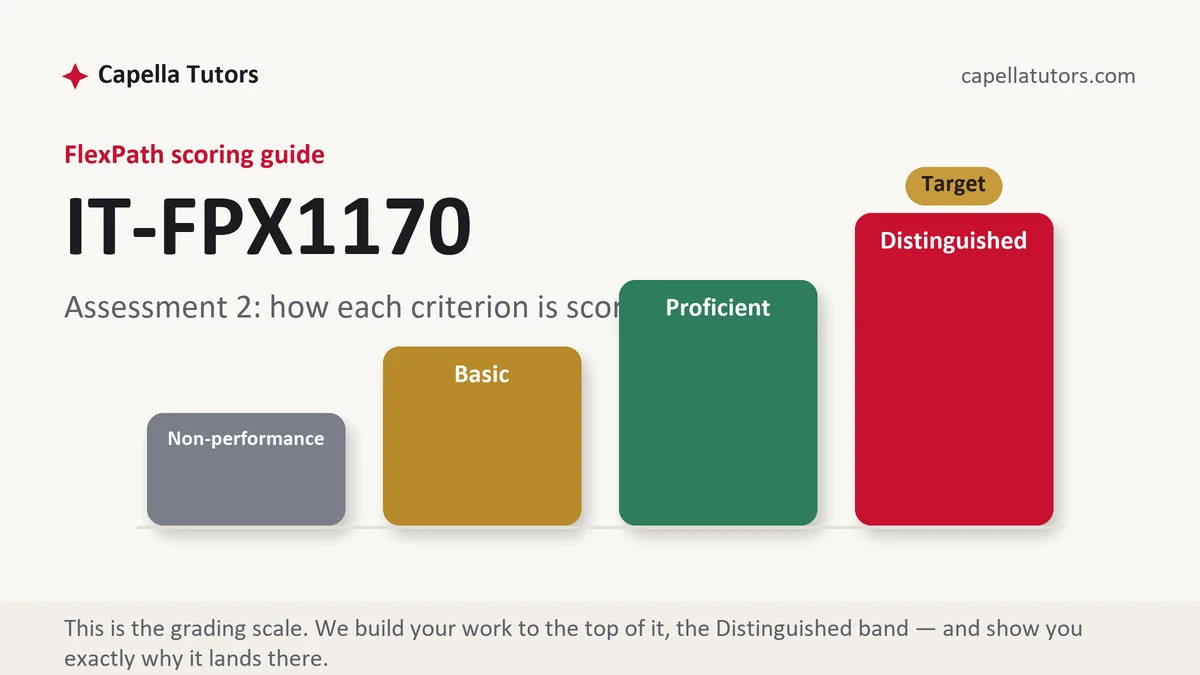
How IT FPX 1170 Assessment 2 is scored
FlexPath resolves criteria to levels rather than to percentages, and the four descriptions double as an outline of what to write:
| Level | What it means on a conflicting-duties analysis |
|---|---|
| Distinguished | Both obligations are stated at their strongest, the harms are ranked by severity and by whether they can be undone, and the paper names what would have to be true for the other decision to be right. That last sentence is the one the column is fishing for. |
| Proficient | The conflict is identified and resolved with reasons that hold. Solid analysis, one move below the top of the guide. |
| Basic | One duty argued and the other mentioned in passing, so the conflict is described rather than resolved. The usual resting place for a second case paper. |
| Non-performance | The opposing obligation never appears at all, which leaves the row that pays for it empty. A criterion drops to the floor for being absent rather than for being weak. |
Ranking is the skill this deliverable is really testing. Two obligations that agree tell a reader almost nothing, while two that disagree force you to say which consideration governs and why, and that single sentence carries more weight than any amount of summary around it.
The IT FPX 1170 Assessment 2 method, step by step
-
Choose a case where the duties genuinely collide
A scenario with an obvious villain produces a paper with nothing to analyse. Look for the situations practitioners actually get stuck in: an instruction that is lawful but undisclosed, a shortcut that protects a deadline and weakens a control, a disclosure that helps one party by exposing another. Difficulty on the page is what the analysis rows are built to reward.
-
List every party, then say what each one loses
Not who is involved, but what each of them stands to lose in concrete terms: money, employment, privacy, safety, standing. Write it as a short table if that keeps you honest. Parties who cannot speak for themselves in the scenario are the ones most often left out, and leaving them out is visible.
-
Rank the harms by severity and by reversibility
Two questions do the ranking. How bad is it, and can it be undone. A loss that can be repaired next week sits below one that cannot be repaired at all, and stating that ordering explicitly turns a list into an argument. This is the paragraph that most often lifts the analysis row a level on its own.
-
Build the opposing case as if you believed it
Write the strongest available argument for the course of action you are going to reject, using the same provisions and the same evidence standard you used for your own. A strawman is worse than no counterargument, because it shows the writer knew the objection existed and chose to weaken it.
-
Say what would have to change to flip your answer
One sentence: name the fact that, if it were different, would make the other decision correct. It demonstrates that the reasoning is doing work rather than decorating a conclusion, and it closes the gap an evaluator would otherwise write into the margin for you.
-
Check the register, then self-score
First person is usually acceptable in this course, and reflection is often required, but a reflective sentence still has to point at something outside your own head: a provision, a statute, a documented incident, a published requirement. Then grade yourself row by row and upload early in the week.
A structure that maps to the criteria
Planning targets our tutors use on a conflict analysis of this length rather than rules issued by Capella; expand any section your guide asks more of.
| Section | What it must do | Guide |
|---|---|---|
| The situation and the instruction | What was asked of you, by whom, and under what constraints of time and authority. | ~180 words |
| The obligations in tension | Both duties named with their provisions, each stated at full strength before either is weighed. | ~280 words |
| Stakeholders and ranked harms | Who loses what, ordered by severity and by whether the loss can be reversed. | ~280 words |
| The opposing course, argued | The best case for the decision you will not make, built from the same sources. | ~220 words |
| Resolution and conditions | Which obligation governs, why, and the fact that would change the answer. | ~200 words |
| Reflection and references | What the analysis changed in your own thinking, plus current APA both ways. | as needed |
Annotated sample excerpt
An original excerpt from our team, showing what ranked harms sound like on the page. Take the structure, then write it around the parties in your own scenario.
The request arrived as a single line from the operations director: put the monitoring agent on all forty-one staff laptops this week, and do not raise it with staff.1 Three parties carry a loss here and they carry different ones. The employer risks having no record if a dispute over conduct reaches a tribunal, forty-one employees risk losing any ability to know what is captured about them or to object to it, and I risk either a contract or an obligation depending on which way I move.2 Those are not equivalent. The employer's exposure is a documented risk it can reduce tomorrow by publishing the policy it already drafted, while a month of silently collected keystrokes cannot be uncollected, so the irreversible harm outranks the recoverable one and the recommendation follows from that ordering.3
- 1Quotes the instruction rather than summarising it. The words do not raise it with staff are the whole case, and paraphrasing them away would soften the conflict the criterion wants analysed.
- 2Three parties, three concrete losses, including the writer's own. Naming your own exposure is honest and it stops the paper reading as a lecture delivered from outside the situation.
- 3Does the ranking out loud and gives the ground for it, which is reversibility. This is the sentence that converts a stakeholder list into the analysis the row is written about.
The full premium sample for your exact assessment, written fresh to your scoring guide and issue, is free to request. Study it, revise it into your own voice, and submit work you understand.
The five mistakes that cost Distinguished
- A scenario with no real conflict in it. An obvious wrong answer leaves nothing to weigh, so the analysis rows have no material to score.
- The opposing position built weak on purpose. An evaluator recognises a strawman instantly, and it damages the paper more than omitting the objection would.
- Parties who cannot speak left off the list. The stakeholders least able to object are usually the ones bearing the largest harm, and their absence is the first thing a marker notices.
- Harms ranked by nothing in particular. An ordering without a stated ground is a preference, and the criterion asks for the reasoning behind the order rather than the order itself.
- A reflection that points only inward. Feelings about the case are not evidence, so every reflective claim still needs a provision, a statute or a documented source behind it.
Pre-submission checklist
- Two obligations named, each stated at its strongest before either is weighed
- Every affected party listed with a concrete loss attached
- Harms ordered by severity and reversibility, with the ground for the order stated
- The rejected course of action argued fairly from the same sources
- One sentence naming the fact that would reverse your decision
- Each criterion self-scored, and identifying details removed, before upload
Conflicting duties to untangle?
Send the scenario, the criteria and the code your courseroom uses. The sample returns in 24 to 48 hours with both obligations argued at strength, the harms ranked on stated grounds, and the opposing case given its due. A scoring-guide reviewer grades it against every row before it reaches you, and revisions are free until it clears.