This manual is for IT FPX 1170 Assessment 1, start to submission. Assessment 1 of IT FPX 1170, Goals and Ethics for the IT Professional, is usually the course's first case analysis: a situation set out in facts, a professional code applied at clause level, and a decision stated with its cost attached. FlexPath grades it one criterion at a time against a scoring guide, and sincerity earns nothing here, because the rows are written about applied judgment rather than about conviction. Below is the method our tutors use, a structure taken from the criteria, and an annotated sample excerpt. Want it off your desk? A premium original sample for this exact assessment returns in 24 to 48 hours and is revised free until the guide is met. Capella's catalog lists the course as IT-FPX1170, and some courserooms print IT1170; both point to this same Assessment 1.
One honesty note before the manual: Capella revises courses and scoring guides over time, so always write to the exact scoring guide attached to your assessment in the courseroom. The course identity above is verified on capella.edu; the method and structure below are our tutors' approach to it, not Capella's official rubric text.
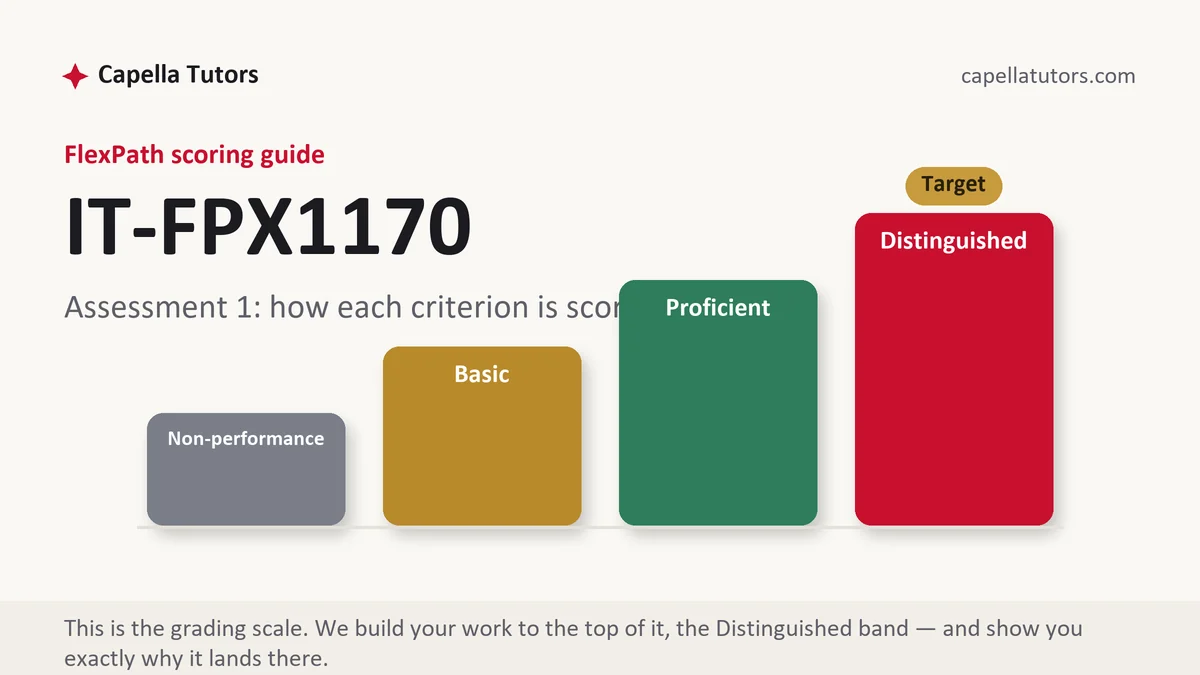
How IT FPX 1170 Assessment 1 is scored
There are no letter grades to chase in FlexPath. Every criterion is placed at one of four levels, and the level text is the specification for the paragraph beneath it:
| Level | What it means on an ethics case analysis |
|---|---|
| Distinguished | The facts are separated from your inferences, named provisions are quoted and explained before they are applied, and the decision states what it costs you. The residual risk you accept is usually the sentence the top level was written to find. |
| Proficient | The code is applied correctly to the facts and a defensible decision follows. Complete work, one admission short of the column above it. |
| Basic | A summary of the situation with a verdict attached, the code named somewhere near the top and abandoned after that. Most first case papers land here. |
| Non-performance | A required element never appears, most often the code itself or the alternative you rejected. An empty row scores as empty regardless of how the rest reads. |
Work at clause level from the first paragraph and the rest of the course gets easier. These codes are organised into numbered sections precisely so that a writer can point at one, and a paper that points is graded differently from a paper that gestures.
The IT FPX 1170 Assessment 1 method, step by step
-
Split the guide into its two questions
Nearly every criterion in this course is asking either what the obligation is or what you decided to do about it. Sort the rows into those two piles before drafting, because the first pile is written from documents and the second is written from reasoning, and mixing the registers is the most common structural problem in a submission here.
-
Set out the facts, and label anything you assumed
Write what happened, who was involved, what was known and when, in short sentences with no judgment attached. Then mark every gap you filled in as an assumption, in the text where you filled it. A paper that separates the two reads as careful; a paper that presents an inference as a fact loses the row about analysis before the analysis starts.
-
Quote the provision, then say what it requires
Name the code and its edition year, give the section number of each provision you rely on, and paraphrase what the provision actually asks for before you touch your own facts. A code named in the opening and never used again leaves the application criterion empty, which is the single most expensive omission available in this course.
-
Find the provision that argues against you
The interesting cases are the ones where two obligations pull opposite ways: a duty to report a known risk against a duty to keep a client's information confidential, or a duty to the public against a commitment made to an employer. State both fairly, then say which governs here and why. Resolving a conflict in writing is what the top column of an ethics rubric is describing.
-
Decide, and name the price of deciding
Recommend one course of action in plain words, including the option of doing nothing where that is genuinely on the table. Then write the cost: the contract that may end, the relationship that becomes awkward, the risk that remains even after you act. A decision with no price has not been made, it has been announced.
-
Strip the identifying detail, then self-score
Confidentiality is one of the obligations under discussion, so breaching it inside the paper is noticed. Remove names, client identities, internal document references and any job title specific enough to identify a person. Then score each criterion yourself at one of the four levels and submit with room to spare, since evaluation can take two business days.
A structure that maps to the criteria
The targets below are planning figures our tutors work to on a case analysis of this size, not Capella requirements; grow whichever section your own guide weights most.
| Section | What it must do | Guide |
|---|---|---|
| The facts | What happened, in what order, and what each party knew at the time, with assumptions marked as assumptions. | ~200 words |
| The code and the clause | The code invoked, its edition, the numbered provisions in play, and what each one requires. | ~250 words |
| Stakeholders and harms | Every party the decision touches and what each stands to lose, ranked rather than listed. | ~250 words |
| Alternatives weighed | The realistic courses of action including inaction, with the strongest opposing option given its case. | ~250 words |
| Decision and cost | The action recommended, why the governing obligation governs, and the risk that remains after acting. | ~200 words |
| Limits and references | What your reasoning cannot settle, plus current APA matched in both directions. | as needed |
Annotated sample excerpt
A passage from an original model written by our team, at the register the top column describes. Study how it holds facts apart from judgment, then build your own around your own case.
While clearing a jammed print queue on a shared workstation at a client site, I found a folder sitting beside the spool directory that held roughly 1,400 customer invoices, readable by every account on the domain.1 My contract covers printer support and nothing else, and I opened no invoice beyond confirming the file type, which is a fact rather than a defence and I record it as one.2 The provision on respecting privacy asks that information be collected for a stated purpose and used only for that purpose, and the provision on avoiding harm asks that a known risk be reported to those able to act on it; read together they point at the same first step, which is telling the client's named technology contact in writing the same day.3
- 1Opens on the situation with a number in it. How many records and who could read them are the two facts the whole analysis will rest on, so they arrive before any argument does.
- 2Separates what was done from what it means, and says so explicitly. An evaluator reading this knows the writer understands the difference between evidence and self-justification.
- 3Names two provisions and states what each requires before applying either. In your own paper give each one its section number and the edition year from the published code rather than describing it loosely.
The full premium sample for your exact assessment, written fresh to your scoring guide and issue, is free to request. Study it, revise it into your own voice, and submit work you understand.
The five mistakes that cost Distinguished
- A verdict delivered where a provision was asked for. Strong feeling about a case reads on the page as an absence of analysis, and the row was written to detect that absence.
- The code mentioned once, then left behind. Everything after that is instinct, and instinct cannot satisfy a criterion about applying a professional standard.
- Compliance treated as the finish line. Statutes set the floor these codes are built on, so a paper that stops at what is lawful stops before the grading begins.
- Harms listed in a row as though they weighed the same. One person's inconvenience and a thousand people's exposed records are not equivalent, and the ranking is the analysis.
- A client or colleague still identifiable in the write-up. The paper breaches the obligation it is arguing about, which is the one irony an evaluator will always mark.
Pre-submission checklist
- Facts written first, with every assumption labeled where it appears
- Code named with its edition, and each provision given its section number
- What each provision requires stated before it is applied to your situation
- The competing obligation stated fairly and then answered on the merits
- A decision with its cost and its residual risk both on the page
- Names, clients and identifying titles removed before the file is uploaded
Ethics case due?
Send the scenario, the criteria and the code your section works from. A premium original sample comes back inside 24 to 48 hours arguing from numbered provisions, with the facts held apart from the inferences and the decision priced. Revisions are free until the guide clears, and faculty comments re-enter the same queue at no charge.