This manual is for ENG FPX 2250 Assessment 3, start to submission. The final deliverable in Academic Research and Writing usually asks for the researched paper the whole course has been building toward, organized by idea rather than by author and resting on a citation record that survives being checked. Themes instead of summaries, a disagreement explained rather than reported, and a reference list matched line by line in both directions are what the criteria buy. Our tutors' method comes next, then a section order taken from the rows, then a paragraph annotated line by line. Rather hand the paper across? A premium original paper written to your own criteria arrives inside 24 to 48 hours, and revisions continue free until the guide is met. Capella's catalog lists the course as ENG-FPX2250, and some courserooms print ENG2250; both point to this same Assessment 3.
One honesty note before the manual: Capella revises courses and scoring guides over time, so always write to the exact scoring guide attached to your assessment in the courseroom. The course identity above is verified on capella.edu; the method and structure below are our tutors' approach to it, not Capella's official rubric text.
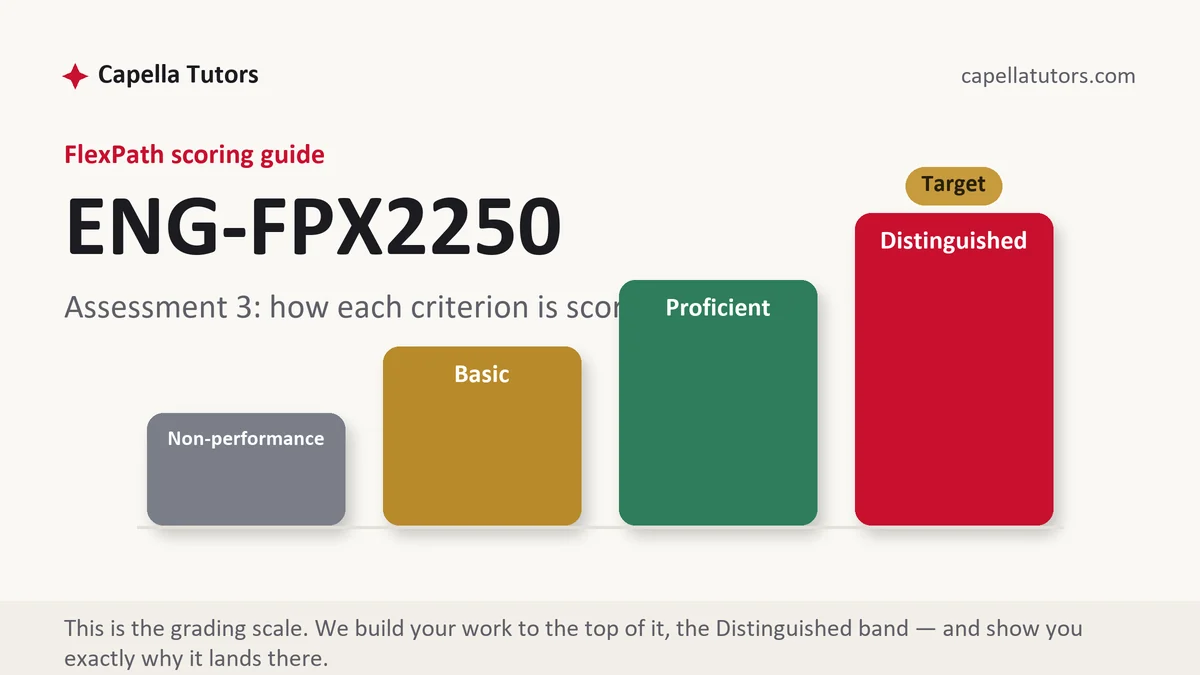
How ENG FPX 2250 Assessment 3 is scored
No letter grade is issued anywhere in FlexPath. Each criterion lands on one of four levels, and the wording of the level you are aiming at is the brief:
| Level | What it means on a researched paper |
|---|---|
| Distinguished | Paragraphs are organized around themes, several sources are held in one sentence with the relationship between them stated, the disagreement in the literature is explained from the methods, the conclusion claims only what the evidence licenses, and every citation and entry account for each other. The move the top column wants is in its own wording, and doing it deliberately is the whole gap. |
| Proficient | Sources synthesized accurately, the argument supported, APA correct. Strong work, one row short of the top. |
| Basic | An annotated bibliography with a different title: one paragraph per source, in the order they were read. This caps an otherwise clean paper. |
| Non-performance | A required element is absent, most often the synthesis, or a reference list that does not match the text. |
Because the course is worth 3 general education points and sits in the Communication category, the evaluator reading your paper is unlikely to know your topic. That is what makes the two-way reference check more than housekeeping: the citation record is the only route a stranger has to your evidence.
The ENG FPX 2250 Assessment 3 method, step by step
-
Make the rows into headings, then build a matrix
Sources down the left, themes across the top, each cell holding what that source says about that theme. Empty columns are themes nobody has studied and are worth a sentence. Full rows usually mean the source is a review rather than a study. The matrix, not the order you did the reading in, is where your outline comes from.
-
Write one paragraph per theme
Open with what several sources agree on, name the one that disagrees, close with your reading of why. A reader who finishes the paragraph should know something no single article said. One paragraph per source, however well written, is the structure the Basic column exists to describe.
-
Take notes so patchwriting cannot happen
Read the paragraph, close the article, write what it said without looking, then reopen only to check accuracy and capture the page. That single habit removes the commonest originality problem in the course, which is not copying but the halfway version: the source's sentence shape kept, synonyms dropped in, a citation added at the end.
-
Explain a disagreement from the methods
Say three studies report more new business registrations after a municipal network goes live and a fourth finds nothing. Reading the methods and noticing that the null study covered two years while the positive ones covered five, or that one counted registrations and another counted firms with payroll, produces a paragraph that explains instead of listing.
-
Size the claim to the evidence
A conclusion is a claim about what the body of work supports, not about what you hoped it would. Write the strongest version, then walk it back a step at a time until the sources can carry it, and say plainly what remains unsettled. A conclusion with a named limit reads as judgment; the same conclusion without one reads as enthusiasm.
-
Run the reference check in both directions, then score yourself
Read the paper through and tick each entry as you meet it, then read the list from the top and find each entry back in the paper. An unticked line is either a source you cut or a citation that never arrived. Confirm the year matches at both ends, since a 2019 in the text against a 2020 in the entry is the single most frequent fault in submitted work.
A structure that maps to the criteria
Word targets here are our tutors' planning figures for an undergraduate research paper, not Capella rules; the scoring guide decides length and shape.
| Section | What it must do | Guide |
|---|---|---|
| Introduction and question | The question, why it is open, and the claim the paper will support, stated in the final sentence. | ~180 words |
| Method of the review | Where the sources came from, the rule that kept them, and how the paper is organized. | ~180 words |
| Theme one and theme two | What the evidence agrees on, source by source inside your own sentences, grouped by idea. | ~350 words |
| The disagreement explained | The studies that conflict, their designs side by side, and your account of why they differ. | ~300 words |
| Conclusion and limits | The claim the evidence licenses, and the question it leaves open, named specifically. | ~200 words |
| References | Current APA, alphabetized, DOIs as links, ticked against the text in both directions. | as needed |
Annotated sample excerpt
A model paragraph from our team, taken from the section where most drafts lose the synthesis row. Learn how the sources are held together, then build yours the same way.
Across the studies measuring business formation after a city network goes live, the effect appears early and then flattens, which is easier to see once the counting windows are lined up.1 Ferraro et al. (2022) and Nakamura and Bell (2023) both report more new registrations in the first two years, while Oduya (2024), working from the same state filing data across five years, finds the rise concentrated in the first eighteen months and no difference by year four.2 The disagreement is a matter of window rather than of finding, and it matters for policy, since a council told to expect sustained growth has been sold a two year result stretched across a decade.3
- 1The paragraph opens on an idea rather than on an author, and it announces the explanation it is going to offer instead of promising a discussion.
- 2Three sources sit inside one sentence with the relationship between them stated, and each arrives with the data and the period it used.
- 3The explanation names the methodological reason the sources differ, then says what follows for a reader. That is the sentence the top row is written for.
The full premium sample for your exact assessment, written fresh to your scoring guide and issue, is free to request. Study it, revise it into your own voice, and submit work you understand.
The five mistakes that cost Distinguished
- One paragraph per source. Summaries in the order the sources were read is a filing system, and it caps the synthesis row no matter how good the sentences are.
- Synonyms dropped into a borrowed sentence. A citation does not repair a paraphrase built on somebody else's structure, and the pattern shows even when no phrase is long enough to flag.
- Three names in one bracket after four sentences. A reader cannot tell which source claimed what, and the attribution row is scored on exactly that.
- Years that disagree across the paper. One mismatched date invites the evaluator to check every other one, and they usually find a second.
- A conclusion larger than the evidence. A claim the sources cannot carry costs more than the smaller claim they could have carried.
Pre-submission checklist
- No body paragraph is organized around a single source
- At least one sentence holds two or more sources with the relationship stated
- The disagreement in the literature is explained from designs, samples or periods
- Every paraphrase was written with the article closed
- Text ticked against the reference list and the list ticked back against the text
- Years and author strings agree at both ends, current APA, self-scored D on every row
Research paper due and the sources will not line up?
Send the prompt, the criteria and whatever you have gathered. A team of eight, including a research analyst and two QA reviewers, returns a premium original paper in 24 to 48 hours organized by theme, with a reference list checked in both directions and revisions free until the guide clears.