This manual is for ENG FPX 2250 Assessment 2, start to submission. The middle deliverable in Academic Research and Writing usually asks you to judge sources rather than collect them, and judging means reading design and sample before findings. Type, method, who was studied, what was measured, and what a study cannot show are the things the criteria pay for. The method follows, then the sections the rows ask for, then a single source evaluated with notes in the margin. Want the reading done alongside you? A premium original evaluation written to your own scoring guide comes back within 24 to 48 hours, with revisions free until the rows are satisfied. Capella's catalog lists the course as ENG-FPX2250, and some courserooms print ENG2250; both point to this same Assessment 2.
One honesty note before the manual: Capella revises courses and scoring guides over time, so always write to the exact scoring guide attached to your assessment in the courseroom. The course identity above is verified on capella.edu; the method and structure below are our tutors' approach to it, not Capella's official rubric text.
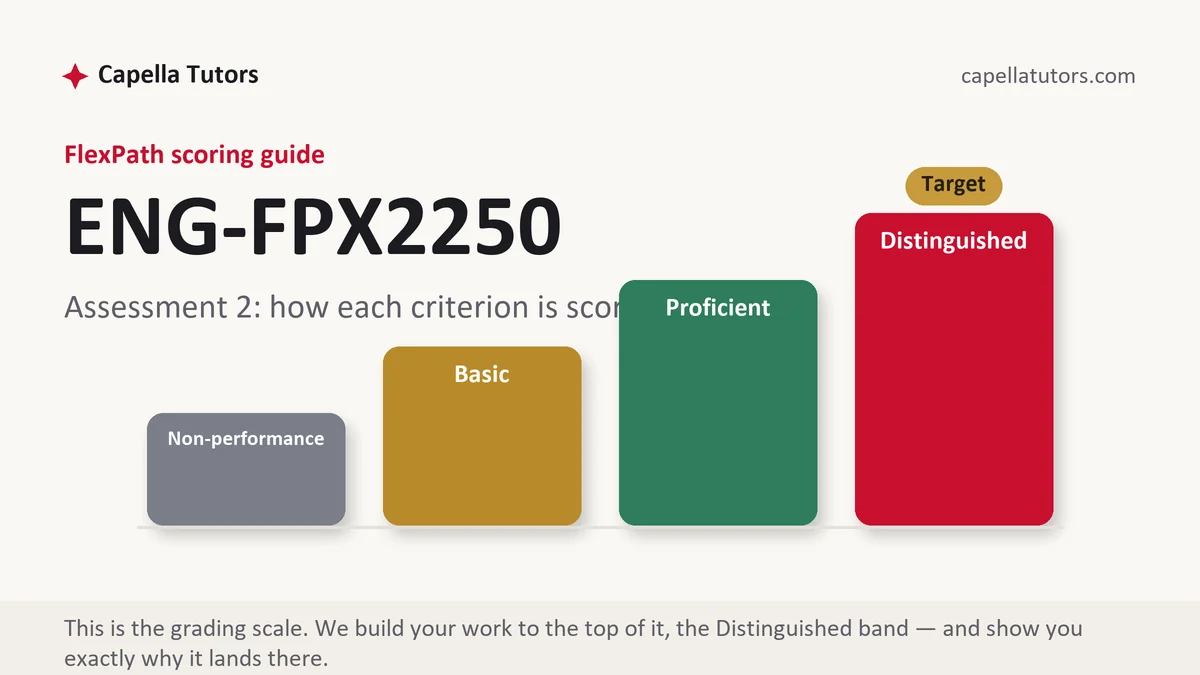
How ENG FPX 2250 Assessment 2 is scored
Every row on the guide is scored separately at one of four levels, with no letter grade at any point, and the level wording is what you are writing toward:
| Level | What it means on a source evaluation |
|---|---|
| Distinguished | Each source is placed by type, its design and sample stated before its finding is used, its limits named, and the weight it carries assigned by method rather than by how neatly the finding fits your argument. Whatever separates the top column from the one below it is written down there; do that and stop. |
| Proficient | Sources correctly classified and accurately summarized with their strengths noted. Careful work, one move below the row above. |
| Basic | Six summaries of six articles, each ending on a sentence saying the source is credible because it is peer reviewed. The usual outcome for a first attempt. |
| Non-performance | A required element is absent, most often the evaluation itself, where a description has been submitted in its place. |
Three general education points sit behind this course, and the habit it installs outlives the topic. A student who can say what a study measured, on whom, and for how long has a defense available in every later course; a student who can only say that a source was peer reviewed does not.
The ENG FPX 2250 Assessment 2 method, step by step
-
Turn the rows into headings and read the verb in each
Describe wants features, evaluate wants stated grounds and a verdict, and compare wants one similarity and one difference. Paste each row into an empty file, put its Distinguished wording underneath, and mark the verb, because a paragraph answering a different verb cannot lift the row however well it reads.
-
Sort the pile by type before you read for content
Peer reviewed research, trade writing and popular coverage of research are three different objects, and only the first was checked by people in the field before publication. A primary report is the study itself; a secondary source is somebody describing it, always shorter and sometimes wrong about it. Label every source before you quote any of them.
-
Read design and sample before findings, every time
Write one plain sentence per source naming who was studied, what was compared or manipulated, how the outcome was measured, and over how long. Thirty-one office workers in one building for six weeks and four thousand across nine employers for two years do not carry the same weight, and the sentence you write here decides which verb you are allowed later.
-
Match the verb to the design
A study that manipulated something and assigned people to conditions can carry reduced. A study that measured two things at one moment carries associated with and nothing stronger. Self-reported discomfort collected by questionnaire is not the same outcome as recorded absence from work, and treating them as interchangeable is the error this course exists to catch.
-
Name the limit the authors named, plus one they did not
Most articles state their own limits in the discussion, and repeating them is the cheap half of the row. The other half is noticing the one they left out: a six week trial cannot speak to a habit, a sample recruited from volunteers who wanted the intervention is not the general workforce, and an outcome measured only by self-report moves with expectation.
-
Assign weight, then score yourself
Say in the document which sources carry your main claim and which only supply context, and give the methodological reason. Then mark each criterion N, B, P or D against your own draft, give anything under D one more pass, and submit early in the week, since an attempt can sit two business days before it is read.
A structure that maps to the criteria
These are the planning numbers our tutors use for an undergraduate evaluation of five or six sources, not rules from Capella; expand any row your guide asks more of.
| Section | What it must do | Guide |
|---|---|---|
| The question and the pile | The question the sources are being judged against, and what kinds of source it turned out to need. | ~130 words |
| Type and provenance | Each source placed as primary or secondary, research or trade or popular, with who published it and why. | ~200 words |
| Design and sample | For each source, who was studied, what was compared, how the outcome was measured and over what period. | ~350 words |
| Findings and the verbs they license | What each study reports, written with a verb its design can actually carry. | ~250 words |
| Limits and weight | The stated limits, one unstated limit, and which sources carry the argument and why. | ~250 words |
| References | Current APA entries with DOIs, alphabetized, accounted for in both directions against the text. | as needed |
Annotated sample excerpt
One model evaluation from our team, showing the order the top of the guide rewards. Study the sequence, then write the version each of your own sources needs.
Halvorsen and Pike (2024) is a primary report of a randomized trial rather than a review, which is why it carries the main claim here.1 Thirty-one office workers at a single insurer were assigned either to sit-stand desks or to their existing desks for six weeks, and the outcome was self-reported back discomfort on a ten point scale collected each Friday.2 That design licenses the verb reduced for a six week window and no longer one, the authors say so themselves, and a limit they do not raise is that participants volunteered after seeing the desks installed, which makes expectation impossible to separate from the effect.3
- 1Type and role arrive in the first clause, so a reader knows what kind of object this is before being told what it found.
- 2Sample, comparison, measure and period are all on the page before the finding, which is the reading order that separates the top two rows.
- 3The verb is matched to the design, the authors' own limit is credited, and one limit they omitted is added. That last clause is where the evaluation row is won.
The full premium sample for your exact assessment, written fresh to your scoring guide and issue, is free to request. Study it, revise it into your own voice, and submit work you understand.
The five mistakes that cost Distinguished
- Peer reviewed offered as the evaluation. The filter in the database is where judgment starts, and a sentence that stops there has skipped the row entirely.
- A finding quoted with no design attached. A number carries no weight until a reader knows who was studied and how the outcome was measured.
- A causal verb on a measured relationship. Two things counted at one moment cannot carry reduced or because, and this is the first thing an evaluator checks.
- Self-report treated as an objective outcome. A questionnaire score and a recorded absence are different measures, and swapping them changes what the study showed.
- The authors' limitations paragraph copied as your evaluation. Repeating stated limits is the easy half; the row pays for the one nobody mentioned.
Pre-submission checklist
- Every source labeled primary or secondary and placed by publication type
- Design, sample, measure and period written before any finding is used
- Each verb matched to what its study's design can support
- Stated limits credited and one unstated limit named per key source
- Weight assigned by method, with the reason written into the text
- DOIs present where they exist, citations matched both ways, self-scored D throughout
Sources gathered and no idea which ones hold?
Send the question, the articles you have and the criteria. A team of eight, including a research analyst and two QA reviewers, returns a premium original evaluation in 24 to 48 hours with design and sample in front of every finding, revised free until the guide clears.