This manual is for ENG FPX 2250 Assessment 1, start to submission. The opening deliverable in Academic Research and Writing usually grades the part of research that happens before any prose exists: a question narrow enough to answer and a search somebody else could rerun. The question is the hinge, and a search reported in numbers rather than adjectives is what separates the top two rows. The method our tutors run comes next, with a section order taken from the rows and one excerpt annotated in the margin. Would you rather not run the search yourself? A premium original sample written to your own criteria arrives inside 24 to 48 hours, revised at no charge until the rows clear. Capella's catalog lists the course as ENG-FPX2250, and some courserooms print ENG2250; both point to this same Assessment 1.
One honesty note before the manual: Capella revises courses and scoring guides over time, so always write to the exact scoring guide attached to your assessment in the courseroom. The course identity above is verified on capella.edu; the method and structure below are our tutors' approach to it, not Capella's official rubric text.
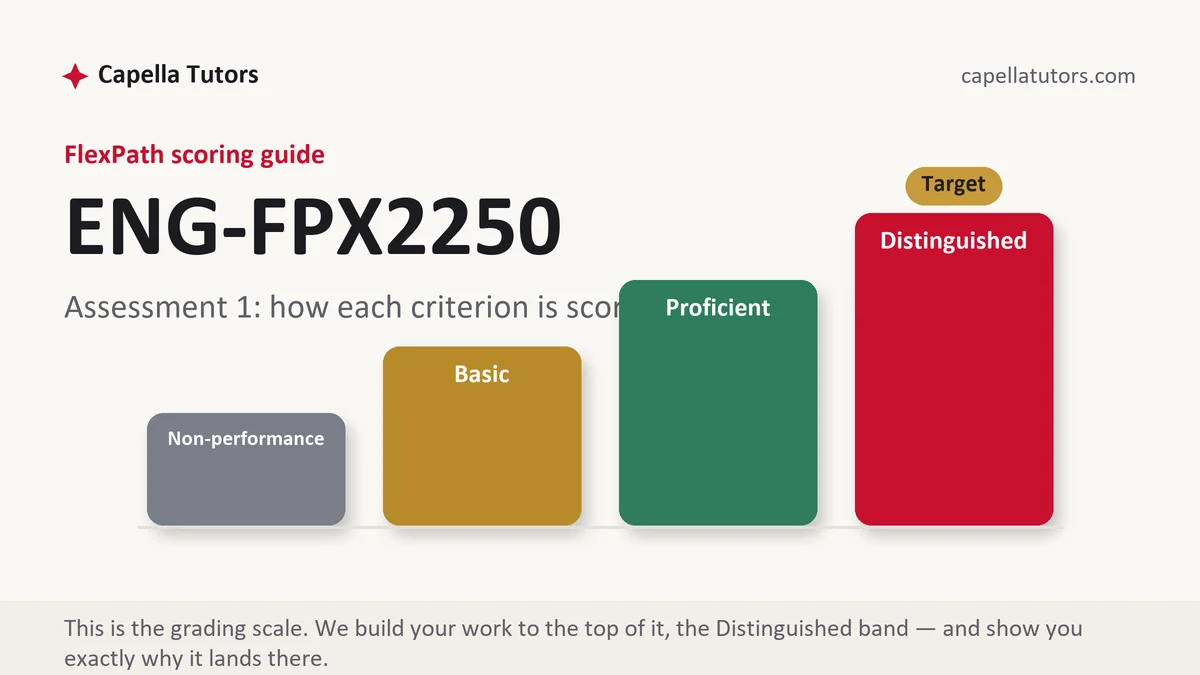
How ENG FPX 2250 Assessment 1 is scored
FlexPath has no letter grades in it. Each criterion is marked at one of four levels, and the description of the level you want is the instruction you are following:
| Level | What it means on a question and search deliverable |
|---|---|
| Distinguished | The question names a population, something that varies and an observable outcome; the search reports databases, strings, filters, dates and counts; the inclusion rule is stated and applied; and the record says which pass produced the sources worth keeping. The step past Proficient is named in the column, so take it from the wording rather than from guesswork. |
| Proficient | A researchable question and a search described accurately enough to follow. Genuinely good work, one row below the top. |
| Basic | A topic offered where a question was asked for, and a search summarized as library databases were used. Where most first attempts land. |
| Non-performance | A required element never appears, most often the search record itself, or the rule used to keep and drop results. |
This is a 3-point general education course in the Communication category, and it is the one course that grades the machinery instead of the prose. Every upper-division course after it spends its rows on content and assumes you can already find a study, which is why a thin pass here surfaces two years later as a research row nobody can rescue.
The ENG FPX 2250 Assessment 1 method, step by step
-
Read the criteria as stages, not as parts of a paper
Rows in this course tend to be named after steps in the work, so a row about locating credible sources is asking you to show how you located them rather than simply to have some. That makes the search itself evidence, and evidence belongs in the document or its appendix wherever your guide allows. Paste the rows in as headings before you open a database.
-
Add the three things a topic is missing
A topic is a noun phrase; a question is a sentence with something that varies in it. School calendars is a topic. Whether districts that moved to a four day week retain teachers at higher rates than comparable five day districts is a question, because you can name the evidence that would answer it. Population, variation, outcome, and the question is finished.
-
Let the database tell you whether the scope is right
Run the question as a search before committing to it. Eleven results means one term has been cut too fine and needs widening. Nine thousand means you are holding three questions and should keep the one you can defend in the space you have. Two minutes of searching settles a scope argument that an hour of thinking will not.
-
Search like somebody who expects to be checked
Build strings rather than sentences: four day week or compressed schedule, joined to teacher retention or teacher turnover or attrition, joined to rural. Quotation marks hold a phrase together, OR widens inside a concept, AND narrows between concepts, and an asterisk on a stem catches its variants. Apply the filters your guide implies and write down the date you ran each pass.
-
Mine the best article backwards and forwards
Open the strongest result, read its reference list for the studies it was built on, then look up the papers that have cited it since. Those two moves separate a real search from a first page of results, and they are usually where the sources you keep come from. Record the count each pass returned, because a number rebuilt later is a number you cannot defend.
-
State the rule you used to keep and drop, then score yourself
Write the inclusion rule as a sentence: peer reviewed, published since 2019, reporting an outcome measured at district level. Then name one result you dropped and why, since a defended rejection is often worth a row on its own. Mark each criterion N, B, P or D against your own draft and submit early in the week rather than late.
A structure that maps to the criteria
The last column holds planning targets our tutors use for an undergraduate search deliverable, not Capella requirements; wherever your guide asks for more, give it more.
| Section | What it must do | Guide |
|---|---|---|
| The question | The question in one sentence, with the population, the variation and the outcome visible inside it. | ~120 words |
| Scope and boundaries | What the question deliberately excludes, and the reason the scope sits where it does. | ~150 words |
| The search record | Databases, exact strings, filters, dates run and the count each pass returned, laid out so it can be repeated. | ~300 words |
| Selection and rejection | The inclusion rule stated, applied, and shown working on at least one source you decided against. | ~250 words |
| What the pile contains | The sources kept, grouped by what each can prove rather than listed in the order they were found. | ~250 words |
| References | Current APA, alphabetized, DOIs where they exist, matched in both directions against the text. | as needed |
Annotated sample excerpt
An original model from our team, written at the register the Distinguished column describes. It is study material: take the reporting habits, then run and record your own search.
This paper asks whether rural districts that moved to a four day school week retain classroom teachers at higher rates than comparable five day districts in the same state.1 The first search ran in Academic Search Complete on 14 March 2026, combining four day week or compressed school schedule with teacher retention or teacher turnover or attrition, limited to peer reviewed articles published since 2019, and returned 43 results.2 Nineteen were kept for full reading under a stated rule, that the article report an outcome measured at district level rather than teacher intention, which is why a widely cited survey of teachers' stated plans to remain was read and then set aside.3
- 1The question carries a population, something that varies and an outcome that could be counted, which is the whole difference between a question and a topic.
- 2Database, strings, filter, date and count are all present, so another student could rerun this pass and land in a comparable pile of sources.
- 3The inclusion rule is stated and then shown working on a source that failed it. A defended rejection is often the cheapest row on the page to win.
The full premium sample for your exact assessment, written fresh to your scoring guide and issue, is free to request. Study it, revise it into your own voice, and submit work you understand.
The five mistakes that cost Distinguished
- A topic submitted where a question was asked for. With nothing that varies, no evidence in the world could count as an answer.
- A search summarized rather than recorded. I researched online describes nothing; databases, strings, filters and counts describe a method.
- Counts reconstructed after the fact. Numbers rebuilt from memory cannot be defended, and they tend to disagree with the search when an evaluator repeats it.
- Everything kept. A pile with no rejections in it suggests the inclusion rule was written after the sources had already been chosen.
- Databases named without strings. Saying you used two library databases leaves out the only part of the search anybody could repeat.
Pre-submission checklist
- The question contains a population, something that varies and an observable outcome
- Every search pass records database, string, filters, date run and result count
- The inclusion rule is written as a sentence and applied consistently
- At least one rejected source is named with the reason it failed the rule
- Backward and forward searching both appear in the record
- Reference list matched to the text in both directions, current APA, self-scored D throughout
Question due and the topic will not narrow?
Send the topic area, any sources your instructor has already approved and the criteria. A team of eight, including a research analyst and two QA reviewers, returns a premium original sample in 24 to 48 hours with a question you can defend in conversation and a search record anybody could rerun.