This manual is for CSC FPX 4902 Assessment 3, start to submission. Assessment 3 in CSC FPX 4902, Computer Science Capstone 2, is usually the closing deliverable: the defect log with causes rather than symptoms, hours estimated set against hours spent, limitations you name before anybody else can, and future work costed instead of gestured at. Something always differs from the proposal, and reporting that difference accurately is a criterion in its own right. The rest of this page gives the order we close a report in, a layout built on the criteria, and an annotated excerpt. Rather have it handled? Send what you have and an original premium sample follows in 24 to 48 hours, with free revisions until nothing on the guide is left open. Capella's catalog lists the course as CSC-FPX4902, and some courserooms print CSC4902; both point to this same Assessment 3.
One honesty note before the manual: Capella revises courses and scoring guides over time, so always write to the exact scoring guide attached to your assessment in the courseroom. The course identity above is verified on capella.edu; the method and structure below are our tutors' approach to it, not Capella's official rubric text.
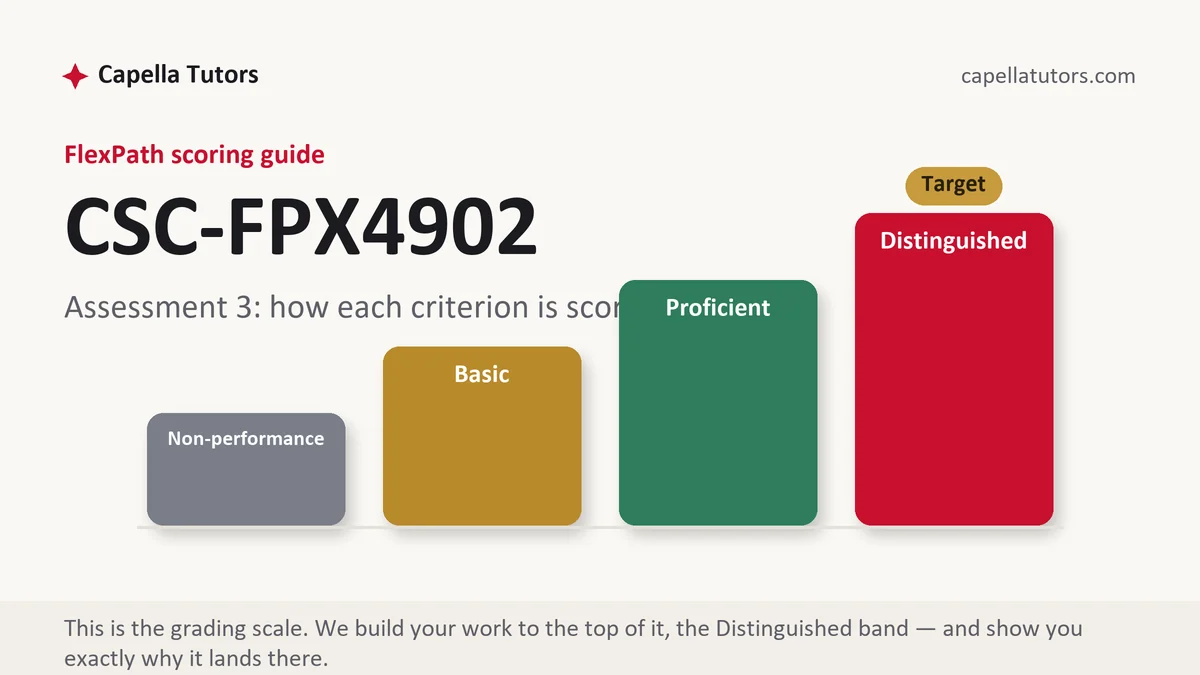
How CSC FPX 4902 Assessment 3 is scored
The guide places every criterion at one of four levels on its own merits. On the closing sections of a final report they generally mean this:
| Level | What it means on defects, variance, and limits |
|---|---|
| Distinguished | Defects carry severity and cause, variance is reported as estimate against actual with an explanation per line, the limitations are volunteered including the scale the system was never tested at, and future work arrives as named tasks with effort beside them. |
| Proficient | A defect log, a variance account, and a limitations section. Complete, with causes described as symptoms and future work left general. |
| Basic | A report where everything went to plan, no defect was serious, and the future work paragraph says the system could be expanded. It reads as untested rather than as excellent. |
| Non-performance | A required element is missing, most often the variance against the plan or any statement of what the system cannot do. |
Measured candour is what scores here. Write up the failures that altered a decision, give each one a cause and a consequence, and omit the ones that altered nothing. A weakness you disclose yourself is far cheaper than the same weakness uncovered by whoever is marking you.
The CSC FPX 4902 Assessment 3 method, step by step
-
Criteria into headings, then log defects by cause
Each entry records the symptom, a severity, the underlying cause, and the resolution. Cause is the column students fill in with a symptom, so push past the first answer: the import failed is a symptom, the importer assumed every row had a supplier code is a cause.
-
Rate severity against consequence, not against annoyance
A defect that produces a wrong number is more serious than one that produces an ugly screen, whatever order you happened to notice them in. State the rule you used for the ratings so a reader can see the scale was applied rather than felt.
-
Report variance as a table with a reason on every line
Four columns: the task, the estimate you wrote in the proposal, the time it really took, and a line accounting for the gap. A task that ran to three times its estimate is data about how you estimate rather than a confession, and the cause you attach to it is the part being marked.
-
Account for everything that was dropped
Which requirements were delivered, which partly and how far, and which were abandoned, each with the date the decision was taken and what the time went into instead. Abandoning one feature so that two others could be completed and properly tested is a reasonable exchange, and it should be argued as one rather than buried.
-
Write the limitations before your evaluator does
Say what the system does not handle, the scale it was never tested at, the environment it has only ever run in, and the requirement that was let go. This section belongs to you, and volunteering it reads as professional rather than as defensive.
-
Cost the future work, then self-score
Three named tasks with rough hours beside them is a plan; a paragraph saying the system could be extended is worth nothing. Then read each criterion, mark yourself, and rewrite anything short of the top level before this file closes your degree.
A structure that maps to the criteria
The counts below are the planning targets our tutors use for these closing sections, not Capella requirements; expand any part your criteria weight heavily.
| Section | What it must do | Guide |
|---|---|---|
| Defect log | Every defect with its severity, its cause, its resolution, and the rule the severities were rated by. | ~300 words |
| Variance table | Task, estimated hours, actual hours, and one line of explanation for each difference. | ~300 words |
| Requirements delivered and dropped | What shipped, what shipped partly, what was abandoned, with dates and reasons. | ~250 words |
| Limitations | What the system cannot do, the scale it was not tested at, and the environment it has only run in. | ~250 words |
| Future work | Named next tasks with rough effort beside each one. | ~200 words |
| References | Testing and process standards, professional conduct sources, dependency documentation, current APA. | as needed |
Annotated sample excerpt
A final original excerpt from our team, printed as a model of how variance is written as measurement. Take the shape and fill it with your own numbers.
The largest line in the variance table is the supplier importer, estimated at 8 hours in the proposal and finished in 26, and the cause is specific rather than general: three of the store's four suppliers send catalogue files with their own column names and one sends quantities as text with thousands separators, none of which the estimate had allowed for.1 Those 18 extra hours came out of requirement F-12, the stock-movement history view, which was dropped on 12 June so the reconciliation report itself could be finished and tested properly, and that trade is reported here rather than left for the two documents to be compared against each other.2 Two limits belong to the author rather than to the evaluator: the tool has been run against one store's catalogue of about 12,000 items and nothing is known about its behavior at the 60,000 the chain's larger branches carry, and every test has run on one operating system, so the file path handling is unproven anywhere else.3
- 1Gives the estimate, the actual, and a cause specific enough to be useful to the next estimator. Variance written as a finding rather than as an apology.
- 2Says where the extra hours came from and names the requirement that paid for them, with a date. This is the trade a project management criterion is asking to see.
- 3Volunteers a scale limit and an environment limit, both with numbers. Naming the boundary of your own work is what the top column describes.
The full premium sample for your exact assessment, written fresh to your scoring guide and issue, is free to request. Study it, revise it into your own voice, and submit work you understand.
The five mistakes that cost Distinguished
- A report where everything went to plan. An evaluator who has supervised real projects reads that as untested rather than as excellent.
- Causes recorded as symptoms. The import failed is what you saw; the assumption the importer made is what a reader can learn from.
- Estimates edited to match what happened. Revise the estimate after the fact and you have erased the only proof you ever made one.
- Dropped requirements that vanish. A list that has silently shrunk between the two documents is the failure that costs most here.
- Future work as a paragraph of ambition. Three tasks with hours beside them is a plan; the system could be expanded is filler.
Pre-submission checklist
- Every defect carrying severity, cause, and resolution, with the severity rule stated
- A variance table holding estimate, actual, and one explanatory line per task
- Every requirement accounted for as delivered, partial, or dropped, with dates and reasons
- Limitations volunteered, including untested scale and untested environments
- Future work given as named tasks with rough effort beside each
- Borrowed and generated fragments credited, references reconciled both ways in current APA
Build finished and the honest sections unwritten?
Send the repository, the proposal, the criteria, and your own notes on what went sideways. Back comes the defect log with real causes, the variance table with explanations, the dropped requirements accounted for, and the limitations written by us, inside 24 to 48 hours with revisions free until the guide is met. The opening sample is free.