This manual is for CSC FPX 4902 Assessment 2, start to submission. Assessment 2 in CSC FPX 4902, Computer Science Capstone 2, is usually where the evidence itself is graded: individual cases a reader could rerun, totals reported including the failures, and a table pairing every requirement from the earlier course with the case that settles it. An image asserts something and a case demonstrates it, and the criteria are built on that gap. What follows is the order we assemble evidence in, a section layout the criteria set, and an annotated excerpt. Would you rather hand it off? Our tutors produce an original premium sample within 24 to 48 hours and keep revising it, without charge, until every criterion is covered. Capella's catalog lists the course as CSC-FPX4902, and some courserooms print CSC4902; both point to this same Assessment 2.
One honesty note before the manual: Capella revises courses and scoring guides over time, so always write to the exact scoring guide attached to your assessment in the courseroom. The course identity above is verified on capella.edu; the method and structure below are our tutors' approach to it, not Capella's official rubric text.
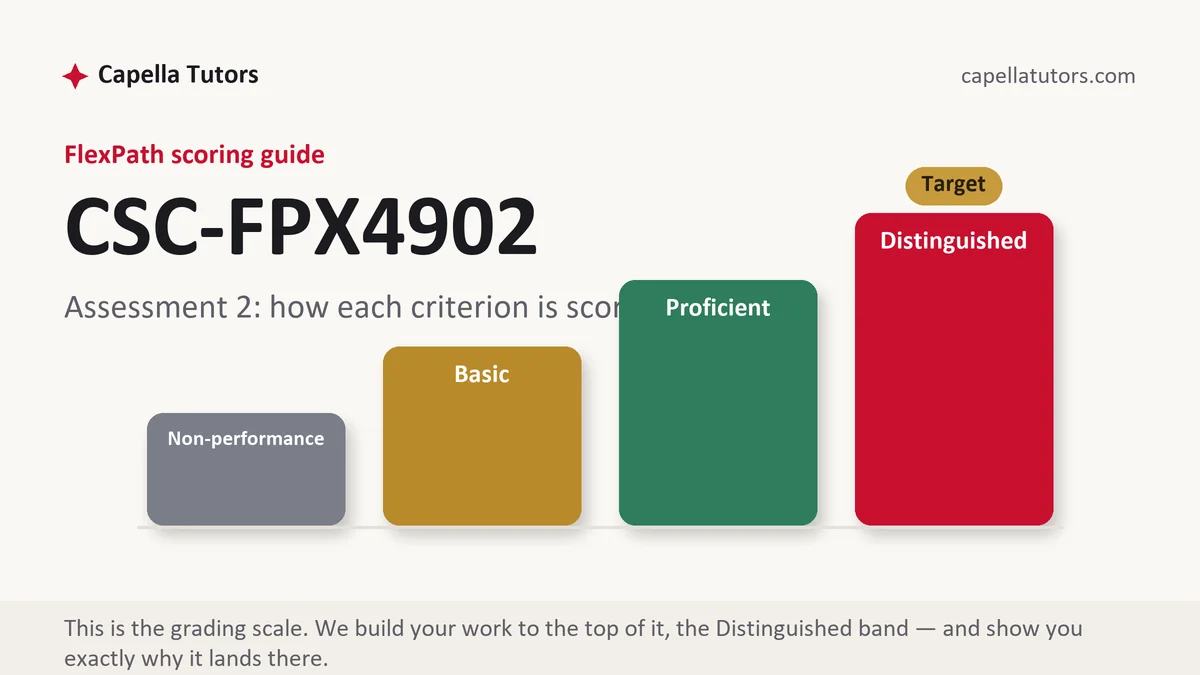
How CSC FPX 4902 Assessment 2 is scored
Levels, one per criterion, marked independently. On test evidence they usually come out like this:
| Level | What it means on test evidence and traceability |
|---|---|
| Distinguished | Cases carry enough detail to be rerun by a stranger, the boundaries are chosen deliberately rather than gathered, the totals include every failure, and no requirement is left unaccounted for, including the ones that were dropped. |
| Proficient | Real cases, a traceability table, and honest totals. Complete, with the boundary cases chosen by convenience rather than by reasoning. |
| Basic | A coverage percentage offered as proof of correctness, or a set of screenshots standing in for cases. Running a line of code says nothing about whether anybody verified its result. |
| Non-performance | A required element never appears, most often the traceability table or the failures the totals quietly omit. |
Build the traceability table first and write the prose around it. Requirement, the case that checks it, the verdict, and a notes column, and every later criterion becomes easier to answer because the evidence is already sitting above the paragraph.
The CSC FPX 4902 Assessment 2 method, step by step
-
Criteria into headings, then lay out the traceability table
One row per requirement from the proposal, with the case identifier that settles it, the verdict, and a note. Fill every row, including the requirements that were descoped, because a blank row is the thing an evaluator notices first.
-
Write cases a stranger could rerun
Give every case an identifier, the requirement behind it, the state the system had to be in, the input exactly as entered, what should have happened, what did, a verdict, and the build number. Eight narrow columns, and a stranger can audit any row without asking you anything.
-
Choose the boundaries by reasoning, not by convenience
For anything numeric, test the value on each side of every threshold and the threshold itself, then the empty case, the single case, and the largest value the type will hold. The interesting defects live in the arithmetic at the edges rather than in the logic in the middle.
-
Report the totals with the failures in them
Say how many cases ran, how many passed, where the failures cluster, which have fixes applied and retested, and which are deferred with the reason. A summary written that way outscores an announcement that everything passed, because it proves two things at once: the suite was real, and your account of your own work can be trusted.
-
Attach a regression case to every fix
A repair with no test behind it is a story. Keep the case that was failing before your change and passing afterwards, name both builds, and place the pair in the document beside the defect it closed.
-
Read coverage honestly, then self-score
Line coverage counts execution rather than scrutiny, and a case that invokes a function and asserts nothing about the result will lift the percentage while establishing nothing. Report the figure with that caveat beside it, then mark yourself on every criterion and lift anything below the top level.
A structure that maps to the criteria
These figures are our tutors' planning targets for an evidence section, not Capella rules; extend wherever your criteria ask for more.
| Section | What it must do | Guide |
|---|---|---|
| Traceability table | Every requirement paired with the case that settles it, its verdict, and a note, with no row blank. | ~250 words |
| Case format | The columns a case carries, and why each one is needed for somebody else to rerun it. | ~200 words |
| Boundary reasoning | The thresholds identified and the values chosen on either side of each, with the reason. | ~300 words |
| Totals and failures | Counts run and passed, where the failures cluster, what was fixed, what is deferred and why. | ~300 words |
| Regression evidence and coverage | The failing-then-passing case behind each fix, and coverage reported with its caveat. | ~250 words |
| References | Testing standards for the vocabulary, framework documentation with versions, current APA both ways. | as needed |
Annotated sample excerpt
Another original excerpt from our team, offered as a model of how a boundary case is chosen and traced. Read the moves, then write your own suite the same way.
Requirement F-04 says worked time is rounded to the nearest quarter hour, so the cases were chosen at the edges rather than in the comfortable middle: TC-11 through TC-15 cover 7 hours 51 minutes, exactly 7 hours 52 minutes and 30 seconds, 7 hours 54 minutes, a zero-length shift, and a negative correction entry of minus 20 minutes issued against a prior week.1 The exact midpoint is the case that mattered: the requirement did not say which way a tie goes, the code rounded it down, the payroll clerk expected it up, and TC-12 is the case that exposed the ambiguity and the requirement was amended before the code was.2 Totals are reported as they stand: 78 of 81 cases pass on build 46, all three failures sit in the negative-correction path, two have fixes with regression cases that failed on build 44 and pass on 46, and one is deferred because it needs a payroll period the test data does not contain.3
- 1Traces a group of cases to one requirement and shows the boundaries were reasoned about rather than collected. That reasoning is what the criterion is marking.
- 2Reports a case that found an ambiguity in the requirement instead of a defect in the code, and says the requirement was fixed first. This is the strongest paragraph a test section can carry.
- 3Gives honest totals with the failures located, the regression builds named, and the deferral explained. Accuracy about your own work is the criterion underneath all of this.
The full premium sample for your exact assessment, written fresh to your scoring guide and issue, is free to request. Study it, revise it into your own voice, and submit work you understand.
The five mistakes that cost Distinguished
- Screenshots offered as the test suite. A picture records one instant of one run, where the criterion wanted something repeatable.
- Coverage read as correctness. Running a line and inspecting its result are separate acts, and a case with no assertion inflates the figure while settling nothing.
- No traceability table. If the requirements and the cases never meet on a page, nobody will do the pairing on your behalf.
- Boundaries picked for convenience. Three values from the middle of the range test the part that was never going to break.
- A fix with no regression case. With no failing case on record beforehand, the repair is only a claim about the past.
Pre-submission checklist
- A traceability table with every requirement accounted for, including descoped ones
- Cases carrying identifier, requirement, preconditions, input, expected, observed, verdict, and build
- Boundary values chosen on either side of every threshold, plus empty, single, and extreme cases
- Totals reported with the failures located and any deferral explained
- A regression case behind every fix, with the failing and passing builds named
- Coverage reported with its caveat, references reconciled both ways in current APA
Suite written and the traceability table blank?
Send the repository, the numbered requirements you wrote last course, and the criteria. Back comes the traceability table filled row by row, cases in a rerunnable format, the boundaries reasoned out, and totals that include the failures, inside 24 to 48 hours with free revisions until your guide is satisfied. No payment on the first sample.