This manual is for CSC FPX 4900 Assessment 3, start to submission. Assessment 3 in CSC FPX 4900, Computer Science Capstone 1, is usually where the proposal has to prove it is buildable: hours counted against the work described, milestones that admit what depends on what, slack left for the week you are going to lose, and risks named while there is still time to act on them. Each criterion is marked on its own against your scoring guide. From here you get the order our tutors plan in, a layout the criteria decide, and an annotated excerpt. Rather have it taken care of? Ask, and an original premium sample lands within 24 to 48 hours, revised at no cost until the criteria stop objecting. Capella's catalog lists the course as CSC-FPX4900, and some courserooms print CSC4900; both point to this same Assessment 3.
One honesty note before the manual: Capella revises courses and scoring guides over time, so always write to the exact scoring guide attached to your assessment in the courseroom. The course identity above is verified on capella.edu; the method and structure below are our tutors' approach to it, not Capella's official rubric text.
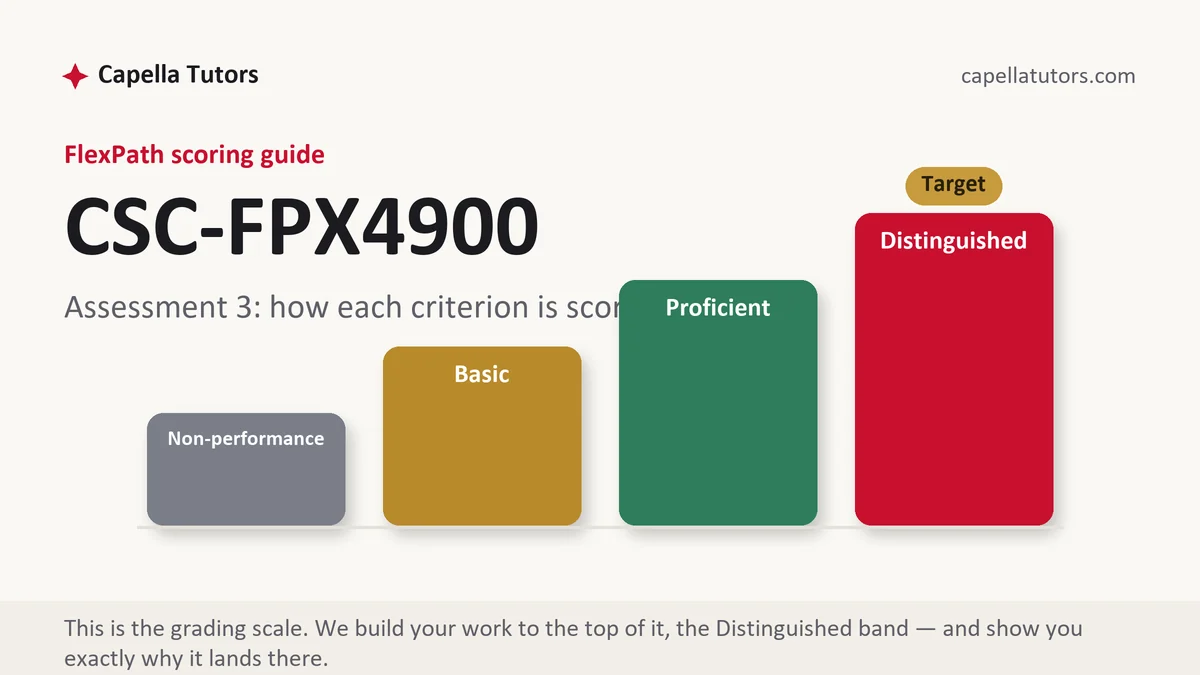
How CSC FPX 4900 Assessment 3 is scored
Four levels, applied criterion by criterion, with no overall score behind them. On planning work the levels usually mean this:
| Level | What it means on a plan and risk register |
|---|---|
| Distinguished | The hours are counted and set against the work, milestones carry their dependencies, at least one week is left empty before the deadline, and every risk has a response one person could carry out alone plus the observable event that triggers it. |
| Proficient | A real schedule with milestones and a register of risks. Complete, with evenly spaced dates and responses stated in general terms. |
| Basic | A timeline of equal weekly blocks and a paragraph about being careful. Nothing is wrong with it and nothing in it would survive one bad week. |
| Non-performance | A required element is absent, usually the feasibility arithmetic or a response against each risk. |
Scope should be arithmetic rather than optimism, and the arithmetic is available to you. Count the hours you will really have, subtract what the writing and testing take, and let the remainder decide how many features the proposal is allowed to promise.
The CSC FPX 4900 Assessment 3 method, step by step
-
Criteria into headings, then count your real hours
Take the weeks in the session, multiply by the hours you will honestly give it, and write the total down. Then subtract the share that goes to writing, testing, and the documents themselves, because that share is real and it is usually about a third.
-
Cut the work into pieces of a week or less
A task estimated in weeks is a task nobody can tell is late. Pieces of a few days each give you a signal early, and they make the dependencies visible, which is the next thing the criterion wants.
-
Say what cannot start until something else ends
Mark the dependencies explicitly. A schedule where everything could run in any order is not a schedule, and the ordering is where the risk actually lives, since one blocked task early can idle three later ones.
-
Leave a week empty before the deadline
A schedule with nowhere to absorb a bad week is a forecast rather than a plan. Mark it as slack rather than as room you secretly intend to fill with extra features, and say in the text what it is there to absorb.
-
Give each risk four fields and a trigger
Likelihood, impact, response, and the observable event that tells you the response is now needed. Four lines to a risk, and the criterion is satisfied by something actionable rather than by a paragraph promising to stay alert. Keep every response inside what one person can execute alone.
-
Check the plan against the requirements, then self-score
Every required requirement should appear somewhere in the schedule, and anything in the schedule that traces to no requirement is work you invented. Then mark yourself on each criterion and rewrite whatever falls short of the top level.
A structure that maps to the criteria
The counts below are the planning targets our tutors use for a deliverable of this shape, not Capella requirements; extend any section your guide weights heavily.
| Section | What it must do | Guide |
|---|---|---|
| Feasibility arithmetic | Hours available, hours reserved for writing and testing, and the remainder set against the work described. | ~250 words |
| Milestones | The work broken into pieces of a week or less, each with a deliverable somebody could look at. | ~300 words |
| Dependencies and slack | What cannot begin until something else ends, and where the empty week sits. | ~250 words |
| Risk register | Each risk with likelihood, impact, response, and the observable trigger. | ~300 words |
| Legal and ethical review | Dependency licences, where any data comes from, and whether the project touches people. | ~200 words |
| References | Project and requirements practice, dependency licences, domain sources, current APA both ways. | as needed |
Annotated sample excerpt
A last original excerpt from our team, printed as a model of a risk written so it can be acted on. Take the shape and fill it with your own dependencies.
Ten hours a week across the twelve weeks of the session is 120 hours, and once the proposal, the test evidence, and the final report have taken their share the build has roughly 80 hours left in it, which is one inspection form that works offline plus a sync routine and a list view, and is not a reporting dashboard as well.1 The heaviest risk in the register is the district's monthly meter extract, whose column headings have changed twice in the past year: likelihood high, impact medium, because a rename breaks the importer rather than the application.2 The response is written so one person can carry it out in an afternoon, which is to validate headers on import and fail loudly naming the missing column, and to keep one real extract in the repository as a fixture so development never waits on next month's file; the trigger is the first import that rejects a header, and the moment it fires the fixture becomes the development input.3
- 1Does the hour arithmetic out loud and converts the remainder into a feature count, then names what the number rules out. Feasibility answered rather than asserted.
- 2Gives the risk a likelihood and an impact and explains the impact rating in half a clause. A rating with a reason attached is a rating an evaluator can accept.
- 3Writes a response one person could finish in an afternoon and attaches an observable trigger. Four fields, and the risk criterion is satisfied with something actionable.
The full premium sample for your exact assessment, written fresh to your scoring guide and issue, is free to request. Study it, revise it into your own voice, and submit work you understand.
The five mistakes that cost Distinguished
- A schedule of equal weekly blocks. Evenly spaced dates with no dependencies are a calendar, not a plan.
- No slack anywhere. One bad week converts a tight timeline into an explanation you deliver next term.
- Risks named with no response. A danger recorded and then left alone on the page is box-ticking.
- Responses that need somebody else. A mitigation requiring a second developer or a paid service is not available to you.
- Hours never counted. A proposal whose feasibility rests on enthusiasm is being marked by a reader who can multiply.
Pre-submission checklist
- Hours available counted, with the share reserved for writing and testing subtracted
- The remainder set explicitly against the features the proposal promises
- Work broken into pieces of a week or less, each with something visible at the end
- Dependencies marked, and at least one empty week before the deadline
- Every risk carrying likelihood, impact, a one-person response, and an observable trigger
- Every required requirement traceable into the schedule, references reconciled both ways in APA
Schedule drafted and the arithmetic does not work?
Send the requirements, the criteria, and the hours you actually have each week. Back comes the feasibility arithmetic, milestones with dependencies and slack, and a risk register with triggers and one-person responses, inside 24 to 48 hours with revisions free until the guide is met. Your first sample comes at no cost.