This manual is for CSC FPX 4900 Assessment 2, start to submission. Assessment 2 in CSC FPX 4900, Computer Science Capstone 1, is usually where intention becomes specification: numbered requirements each carrying the check that would settle it, a design showing how the parts meet, and a rationale saying why this arrangement rather than the obvious alternative. The test is whether another developer could read the document and build roughly the system you have in mind. What follows is the drafting order we use, a section layout the criteria decide, and one annotated excerpt. Would you rather hand this one over? An original premium sample written to your criteria comes back inside 24 to 48 hours, with free rework until the guide is answered end to end. Capella's catalog lists the course as CSC-FPX4900, and some courserooms print CSC4900; both point to this same Assessment 2.
One honesty note before the manual: Capella revises courses and scoring guides over time, so always write to the exact scoring guide attached to your assessment in the courseroom. The course identity above is verified on capella.edu; the method and structure below are our tutors' approach to it, not Capella's official rubric text.
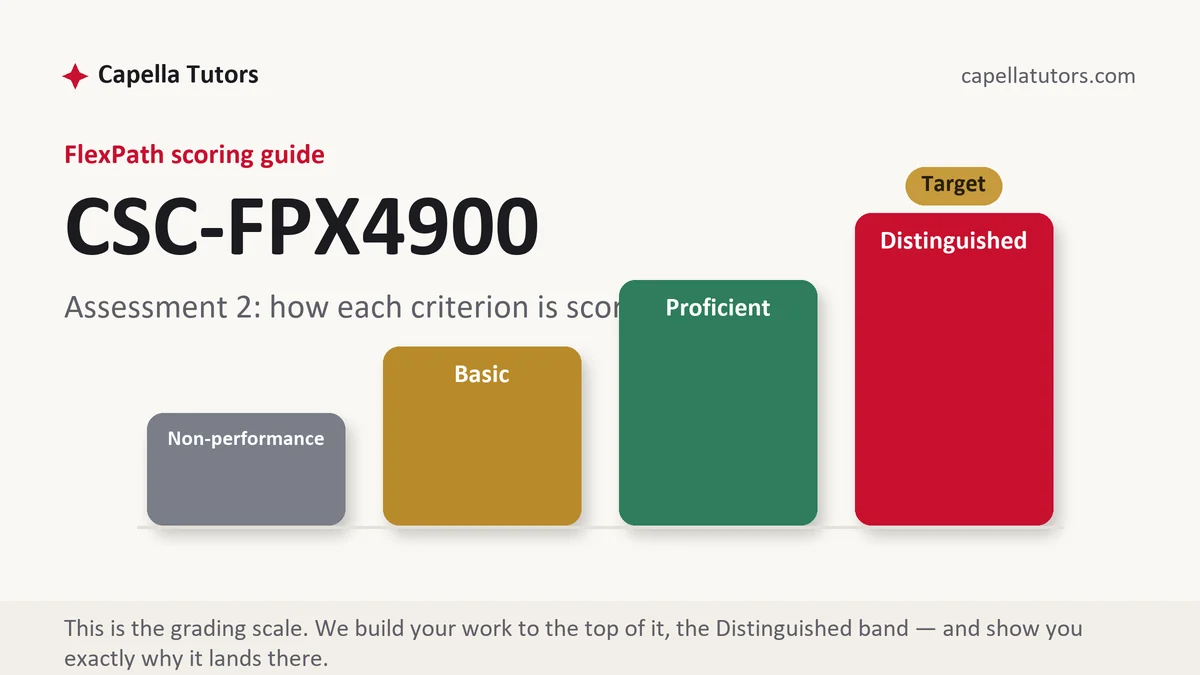
How CSC FPX 4900 Assessment 2 is scored
A criterion here lands on one of four levels and is marked on its own terms. On requirements and design work they usually mean this:
| Level | What it means on requirements and design |
|---|---|
| Distinguished | Every requirement is checkable by a stranger, carries an identifier, and is marked required or desirable, and the design names its components and interfaces with the rejected alternative given its due. The second capstone could trace a test back to any line. |
| Proficient | Numbered, mostly testable requirements and a design a reader can follow. Complete, with the arrangement presented rather than justified. |
| Basic | Requirements written as adjectives, intuitive and robust and scalable, and a design that lists technologies instead of describing structure. |
| Non-performance | A required element never appears, most often the acceptance checks or the non-functional requirements. |
Every line you write is either checkable or aspirational, and what separates them is a figure and a stated condition. Get that right in all of them now, because the next course spends its weeks proving exactly these lines.
The CSC FPX 4900 Assessment 2 method, step by step
-
Criteria into headings, then write requirements one per line with its check
Give each requirement an identifier, a single behavior, and on the same line the check that would settle whether it was delivered. Anything holding two behaviors becomes two requirements, because a half-delivered line cannot be traced.
-
Put a number and a condition into every non-functional line
Fast, easy, and reliable are not requirements. A response time at a stated percentile on a stated data volume on a stated machine is a requirement, and so is a first-time user completing a named task unaided inside a stated time. Both halves can then be checked by somebody with no reason to be generous.
-
Mark each requirement required or desirable
That column is what saves you late in the term when a single task swallows three times its estimate, and it is also what a planning criterion reads as evidence, since an unprioritized list quietly assumes every week will go well.
-
Describe the design as components and interfaces
Name the parts, say what each is responsible for, and say what crosses the boundary between them. A list of technologies is not a design, and a diagram with no interfaces named is a picture. Keep it at a level a second developer could follow without your explanation.
-
Write the rationale, including the option you turned down
For each significant choice, say what else you considered and why this won on your constraints. A design justified against a genuine alternative reads as a decision, and one presented alone reads as the only thing you knew how to build.
-
Read the document as a stranger, then self-score
Hand yourself each requirement and ask whether you could prove or disprove it without asking the author a question. Any line that fails that test gets rewritten. Then mark yourself criterion by criterion and lift anything below the top level.
A structure that maps to the criteria
These figures are our tutors' planning targets for a specification of this kind, not Capella rules; expand wherever your criteria ask for depth.
| Section | What it must do | Guide |
|---|---|---|
| Functional requirements | Numbered single behaviors, each with its acceptance check and its priority. | ~350 words |
| Non-functional requirements | Performance, usability, and reliability lines, each with a number and a condition. | ~250 words |
| Components | The parts of the system, what each is responsible for, and what crosses between them. | ~300 words |
| Data and interfaces | What is stored, in what shape, and the calls or messages the parts exchange. | ~250 words |
| Design rationale | Each significant choice, the alternative considered, and the constraint that decided it. | ~250 words |
| References | Requirements and design standards, comparable tools, dependency licences, current APA both ways. | as needed |
Annotated sample excerpt
Another original excerpt from our team, offered as a model of how a requirement is made checkable. Read the moves, then rewrite your own lines to the same standard.
Requirement F-07, marked required: a member checks a tool out to themselves by entering their membership number and selecting the tool from a list of what is currently available.1 Its acceptance check is written on the same line so the second capstone has something to prove: with 40 tools registered and 3 already out, a member who has not used the system before completes a checkout unaided in under 30 seconds, the tool then shows as unavailable on a second device within one page refresh, and a second attempt to take the same tool is refused with a message naming the current holder.2 The rationale for holding availability in a single database row per tool rather than deriving it from the movement log is worth stating, because the log is the more elegant design and the row is the one a single developer can get right: two people reaching for the same drill press produce one update that succeeds and one that fails loudly, where a derived answer has to be recomputed under contention.3
- 1One requirement, one behavior, one identifier, one priority. A line shaped like this can be traced to a test in the next course without interpretation.
- 2The check names volumes, a time, a device, and a refusal message, so a stranger could run it and disagree with you. That is what testable means here.
- 3Justifies the design against the more elegant option it rejected and names the constraint that decided it. A rationale, not a description.
The full premium sample for your exact assessment, written fresh to your scoring guide and issue, is free to request. Study it, revise it into your own voice, and submit work you understand.
The five mistakes that cost Distinguished
- Adjectives standing in for requirements. Nobody can run a test against the word intuitive, so nobody can confirm you delivered it.
- Two behaviors on one line. A requirement that is half delivered cannot be traced, and the next course has to trace all of them.
- Technologies listed in place of a design. Naming a framework says nothing about what the parts are or what crosses between them.
- No priority column. Without it, the first schedule slip forces an unplanned decision about what to abandon.
- A design with no rejected alternative. One option presented alone reads as the only option the author knew.
Pre-submission checklist
- Every functional requirement numbered, single-behavior, and prioritized
- An acceptance check on the same line as each requirement
- Non-functional lines carrying a number and a condition, not an adjective
- Components named with responsibilities, and every interface between them stated
- A rationale for each significant choice, including the alternative rejected
- Each requirement provable by a stranger without asking you, references reconciled in APA
Requirements written and they still read like wishes?
Send the prompt, the criteria, and the feature list as it stands. Back comes the numbered requirements with acceptance checks and priorities, the components and interfaces, and the rationale against the alternatives you turned down, inside 24 to 48 hours with free revisions until your guide is satisfied. Nothing is charged for the first.