This manual is for CSC FPX 4900 Assessment 1, start to submission. Assessment 1 in CSC FPX 4900, Computer Science Capstone 1, is usually where the project gets chosen and cut down: a problem worth solving, the person who has it, the cost of leaving it alone, and a boundary saying what this project deliberately will not do. Nothing is graded on working software yet, because none exists; it is graded on whether a reader could tell what you intend to build. Below is the order our tutors draft in, a section plan drawn straight from the criteria, and an annotated excerpt. Prefer to hand it off? Our team builds an original premium sample around your own criteria and delivers it inside 24 to 48 hours, revising free for as long as it takes. Capella's catalog lists the course as CSC-FPX4900, and some courserooms print CSC4900; both point to this same Assessment 1.
One honesty note before the manual: Capella revises courses and scoring guides over time, so always write to the exact scoring guide attached to your assessment in the courseroom. The course identity above is verified on capella.edu; the method and structure below are our tutors' approach to it, not Capella's official rubric text.
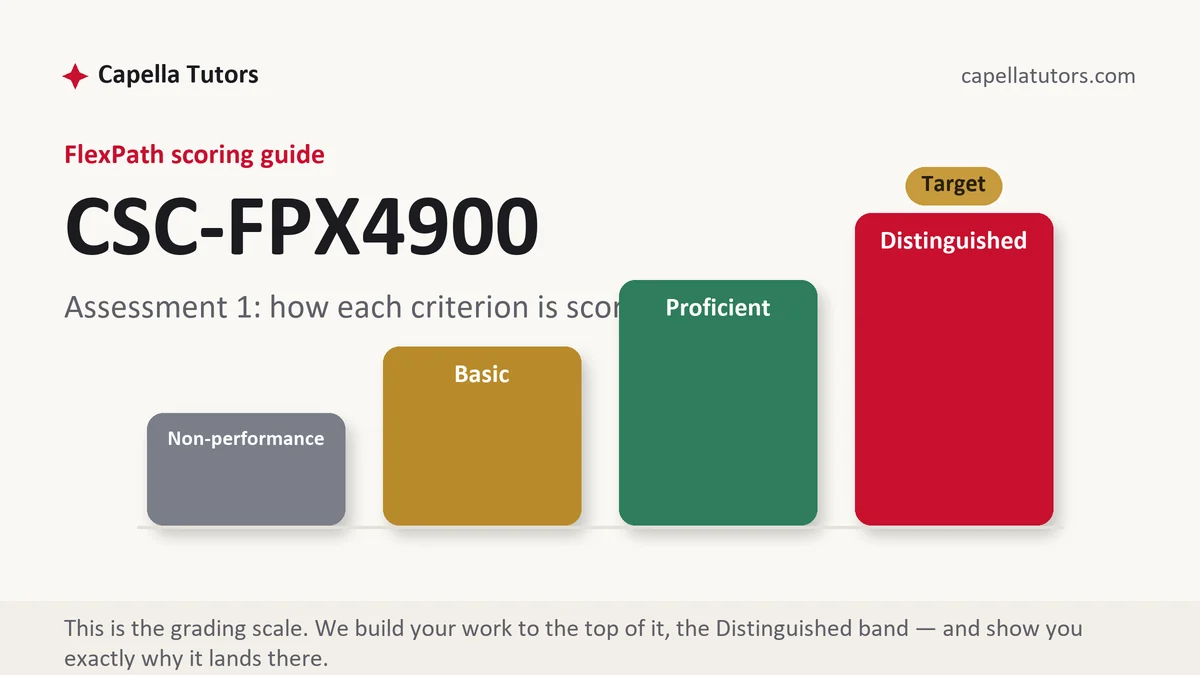
How CSC FPX 4900 Assessment 1 is scored
FlexPath marks each criterion at one of four levels and nothing gets averaged. Here is what those levels tend to describe on a scoping deliverable:
| Level | What it means on a problem statement and scope |
|---|---|
| Distinguished | The problem carries a measurable gap, the stakeholder is described rather than assumed, and the out-of-scope list shows a decision being made. A reader can see what was cut and why it was cut. |
| Proficient | A real problem, a named user, and a stated scope. Complete work, with the boundary drawn but not defended. |
| Basic | A subject area described enthusiastically, the user implied, and the scope open at both ends. This is where the ambitious platform proposal lands. |
| Non-performance | A required element is absent, most often the stakeholder or any statement of what the project excludes. |
Small and finished beats large and half-built on every row of this guide, for the plain reason that a working thing can be shown, measured, and reported. Put that reasoning on the page rather than leaving it implied, and the reader sees a decision instead of a retreat.
The CSC FPX 4900 Assessment 1 method, step by step
-
Criteria into headings, then describe the project in one sentence
One sentence, naming the user, the thing they do, and the result they walk away with. If you cannot finish it without listing features, the idea is still too broad, and every section after this one will carry that fault forward.
-
Work backwards from the demonstration
Decide what you intend to show a reader in ten minutes at the end of the second capstone, then treat everything absent from that ten minutes as a candidate for exclusion. Choosing this way turns a hundred small decisions into one.
-
Write the problem statement with a number in it
Four ingredients earn this criterion: somebody affected, what happens today, what today costs them in hours or money or missed work, and the size of the change you are promising. Drop that last figure and the promise turns into a hope, which is a different thing and marked as one.
-
Describe the stakeholder as if a stranger will meet them
Who they are, what they do today, what today costs them, and what they would accept as success. With no live client available, build the profile as carefully as you would for a paying one and settle the acceptance conditions early, because a stakeholder invented halfway through the term will approve whatever you have already written.
-
Publish the boundary
List what the project will not do, in plain items a reader can check, and give a reason for each exclusion. With no boundary on the page, anything left unfinished looks like a shortfall rather than a choice, and the exclusion list is often the strongest evidence of judgment in the whole document.
-
Test the idea against your own hours, then self-score
Multiply the hours you genuinely have by the weeks available and compare that against the work you have described. If the sum says the build needs double the hours you hold, cut a feature instead of betting on a productive stretch that has not happened yet. Then mark yourself against each criterion and rewrite whatever sits below the top level.
A structure that maps to the criteria
The lengths below are our tutors' planning targets for a scoping deliverable, not Capella limits; grow any section your own guide weights heavily.
| Section | What it must do | Guide |
|---|---|---|
| The project in one sentence | Who uses it, what they do with it, what they get back, with no feature list attached. | ~100 words |
| Problem statement | The situation, who it affects, what inaction costs them, and the size of the change intended. | ~300 words |
| Stakeholder | Their role, their present routine, what that routine costs, and the outcome they would call a success. | ~250 words |
| In scope | The features that appear in the closing demonstration, listed plainly and prioritized. | ~250 words |
| Out of scope | What the project will not do and why each exclusion was chosen. | ~250 words |
| References | Comparable existing tools with their own documentation, domain sources, and current APA both ways. | as needed |
Annotated sample excerpt
A model excerpt written by our team, included to show how a boundary gets defended. Draw your own on the same lines.
The food bank runs four distribution sessions a week and fills them from a group chat, which means the volunteer coordinator spends about five hours a week rebuilding a shift list by hand and roughly one session a month opens short-staffed.1 This project builds a shift board where a volunteer claims or releases a slot themselves and the coordinator sees the gaps, and it succeeds if the coordinator's weekly scheduling time drops below one hour and no session begins under its minimum staffing for four consecutive weeks.2 Three things are deliberately excluded and each for a stated reason: no automated text or email reminders, because a paid messaging service is a dependency and a cost the food bank has not agreed to; no hours reporting for grant paperwork, because it needs data the shift board does not hold; and no mobile application, because the same board in a browser answers the same need inside the hours available.3
- 1Opens on the current situation with two numbers, the hours lost and the sessions missed, so the problem has a measurable size before the solution appears.
- 2States what the system does in one sentence and then defines success as two conditions somebody else could verify. That pair answers the problem criterion.
- 3Publishes the boundary with a reason behind each exclusion. Three defended cuts read as judgment, where an unbounded scope reads as optimism.
The full premium sample for your exact assessment, written fresh to your scoring guide and issue, is free to request. Study it, revise it into your own voice, and submit work you understand.
The five mistakes that cost Distinguished
- A scope that needs a team. Four developers and half a year, proposed by one student, and marked by a reader who can multiply.
- The stakeholder left implied. A project with no described user cannot have acceptance conditions, and the criterion is built on them.
- A problem statement with no number. Without a measurable gap there is nothing for the finished system to be compared against.
- No out-of-scope list. An unbounded project cannot be delivered, only abandoned somewhere in the middle.
- Features chosen before the demonstration. Deciding what to build without deciding what to show produces a project that ends in the middle.
Pre-submission checklist
- The project stated in one sentence with no feature list inside it
- A problem statement holding a person, a current cost, and a measurable intended difference
- The stakeholder described, with acceptance conditions fixed in advance
- In-scope features limited to what the closing demonstration will show, and prioritized
- An out-of-scope list with a reason attached to every exclusion
- The hour arithmetic done honestly, references reconciled both ways in current APA
Idea due and it will not stop expanding?
Send us the prompt, the criteria, and your idea however half-formed it currently is. Back comes the one-sentence project, the problem statement with a measurable gap, the stakeholder profile, and the boundary with a reason behind every cut, inside 24 to 48 hours with revisions free until the guide is met. The first sample is yours free.