This manual is for CSC FPX 4020 Assessment 2, start to submission. Assessment 2 in CSC FPX 4020, Algorithms and Data Structures, is usually where analysis becomes a decision: one structure chosen for a stated workload, the rejected candidates costed operation by operation, and the choice defended by the operation mix rather than by the module you finished last. Your scoring guide decides the criteria, and each one is marked on its own. What comes next is the order our tutors write in, a layout matched to the criteria, and one annotated excerpt. Would you rather delegate it? Our team turns an original premium sample around in 24 to 48 hours and keeps reworking it, at no cost, until your criteria are covered. Capella's catalog lists the course as CSC-FPX4020, and some courserooms print CSC4020; both point to this same Assessment 2.
One honesty note before the manual: Capella revises courses and scoring guides over time, so always write to the exact scoring guide attached to your assessment in the courseroom. The course identity above is verified on capella.edu; the method and structure below are our tutors' approach to it, not Capella's official rubric text.
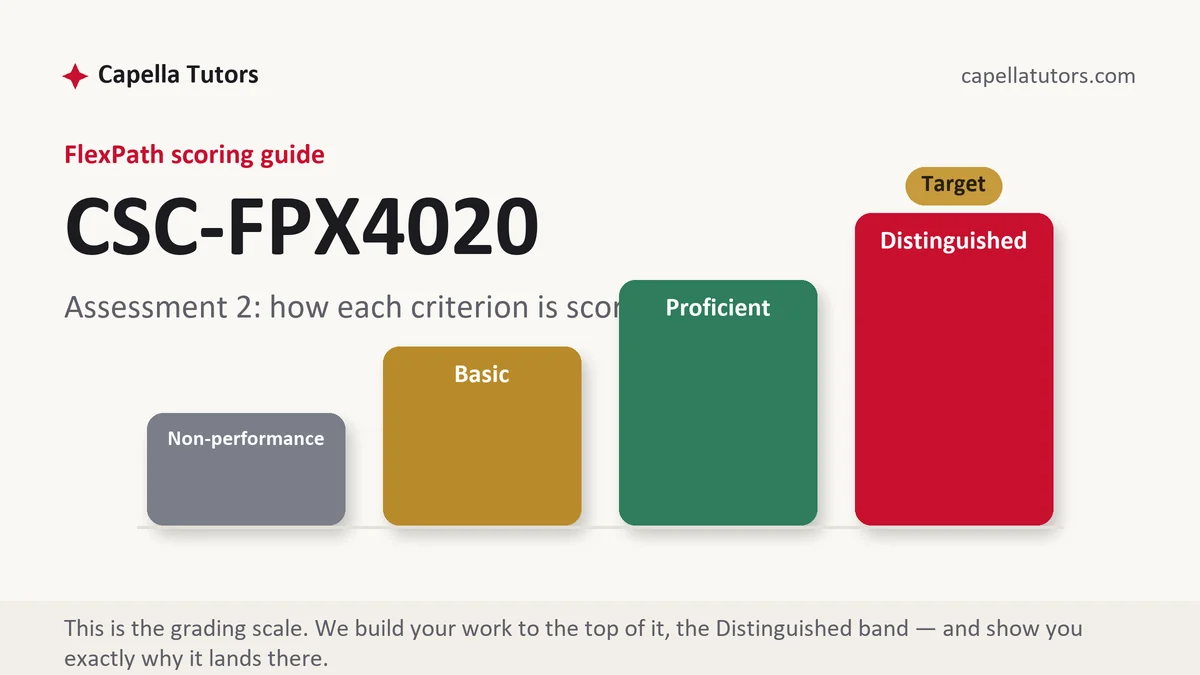
How CSC FPX 4020 Assessment 2 is scored
Criterion levels replace grades in FlexPath. Every row of the guide lands somewhere on this scale, and the wording of the row tells you what to produce:
| Level | What it means on a data-structure selection |
|---|---|
| Distinguished | The operation mix is counted before any structure is named, at least two candidates are priced on the operations that actually run, and the exchange accepted is stated in a sentence. The rejected option is given its real advantage rather than a straw one. |
| Proficient | A defensible structure, correctly costed, with alternatives compared. Complete, and it stops short of naming what the choice surrenders. |
| Basic | A structure announced and then described, with the workload never counted. The description may be accurate and the criterion still asked which operations dominate. |
| Non-performance | A required element is absent, usually the comparison of alternatives or the cost of the operations on each. |
One discipline decides this deliverable. Write the operation mix down before you have a favourite, because a structure chosen first and justified afterwards produces reasoning that a reader can feel was assembled backwards.
The CSC FPX 4020 Assessment 2 method, step by step
-
Turn the criteria into headings, then count the workload
List every operation the program performs, mark roughly how often each runs, and write the list into the document. That list is the evidence behind every later paragraph, and it is the thing most submissions never put on the page at all.
-
Name the operation that dominates
One or two operations usually account for nearly all the work. Find them, and let them drive the comparison, since a structure that is excellent at something the program does twice a day has been chosen for the wrong reason.
-
Price at least three candidates, row by row
Build a table with one row per operation and one column per candidate structure, and fill it with costs rather than with adjectives. Three candidates is enough, and the table does the arguing, because a reader can see instantly which column is cheap where the workload is heavy.
-
Put a number on the difference at your real size
Asymptotic costs do not settle a decision on their own, so state the queue depth or table size you actually expect and work the arithmetic there. A logarithmic operation at a depth of five hundred is around nine comparisons, and a linear shift at the same depth averages two hundred fifty moves, which turns a pair of symbols into a reason.
-
Say what the winner gives up
Every structure surrenders something: ordered traversal, constant-time access by position, predictable memory, simplicity somebody else can maintain. Name the sacrifice in the same paragraph as the choice, since a criterion about justifying a design decision is looking for exactly that admission.
-
Verify the costs you claimed, then self-score
Check each figure in your table against the documentation of the structure you would actually call, not against a general recollection. Then mark yourself criterion by criterion and rewrite whatever falls below the top level.
A structure that maps to the criteria
These targets are our tutors' planning figures for a selection of this kind, not limits set by Capella; extend any row your criteria weight heavily.
| Section | What it must do | Guide |
|---|---|---|
| Workload | Every operation the program runs, with a frequency beside it and the expected size of the collection. | ~200 words |
| Candidates | The structures under consideration and how each one performs the operations that matter. | ~250 words |
| Cost table | One row per operation, one column per candidate, filled with costs and with the dominant rows marked. | ~200 words |
| The arithmetic at your size | The comparison worked at the collection size you actually expect, in counted operations. | ~250 words |
| Decision and sacrifice | The structure chosen, the reason drawn from the workload, and what the choice gives up. | ~300 words |
| References | Standard texts, the documented guarantees of the library you would call, and current APA both ways. | as needed |
Annotated sample excerpt
Another original excerpt from our team, offered as a model of how a decision gets argued from counted operations. Read the moves, then run them on your own workload.
The dispatch desk takes about 4,000 service requests a day, each carrying an urgency value, and the only two operations that matter are adding a request and removing the most urgent one still waiting.1 An unsorted array adds in constant time and then scans the whole queue to find the winner, a sorted array reverses that exchange by shifting on every insertion, and a binary heap charges a logarithmic cost on both, which at a typical waiting depth of five hundred is roughly nine comparisons against the two hundred fifty moves the sorted version averages.2 The heap is therefore the choice, and the thing it surrenders should be said plainly: it holds no usable order below the top element, so the moment the desk asks for a printed list of everything waiting in urgency order, that report costs a full sort rather than a walk.3
- 1Counts the workload first and narrows it to the two operations that dominate. The decision now has something to be measured against.
- 2Prices three candidates on those operations and converts the symbols into counted work at a real depth. This is the paragraph a selection criterion is built to reward.
- 3States the choice and its sacrifice in the same breath, with a concrete request that would expose the weakness. Volunteered limitations read as judgment.
The full premium sample for your exact assessment, written fresh to your scoring guide and issue, is free to request. Study it, revise it into your own voice, and submit work you understand.
The five mistakes that cost Distinguished
- A structure chosen because the module covered it last. The criterion wants to know which operations run most often, not which module you closed most recently.
- No workload anywhere in the document. Without the operation mix, every cost in the paper is unattached to anything.
- Alternatives mentioned and never costed. Naming a rejected option is not comparing it, and the criterion wants the comparison.
- Only asymptotic costs, never arithmetic. Two symbols do not decide a case that a hundred counted operations would settle.
- A winner with no stated sacrifice. Every structure surrenders something, and a paper that finds none has stopped looking early.
Pre-submission checklist
- The operation mix written out with frequencies and the expected collection size
- The dominant one or two operations identified explicitly
- Three candidates priced in a table, one row per operation
- The comparison worked in counted operations at the size you actually expect
- The chosen structure's sacrifice named, with a request that would expose it
- Every cost checked against the documentation of the structure you would call, APA reconciled
Selection section written and it reads like a preference?
Send the workload, the criteria, and the structures your prompt allows. Back comes the operation mix, the priced comparison, the arithmetic at your real size, and the sacrifice stated out loud, inside 24 to 48 hours with free revisions until your guide is satisfied. The first one is free of charge.