This manual is for CSC FPX 4020 Assessment 1, start to submission. Assessment 1 in CSC FPX 4020, Algorithms and Data Structures, is usually the course's analysis deliverable: two procedures set against one another on the same input, with the running time derived from the operation that dominates rather than recalled from a table. It is marked the FlexPath way, criterion by criterion against a scoring guide, and derivation is what the top column buys. Below you get the method our tutors use, a structure that maps to the criteria, and an annotated sample excerpt. Prefer to hand it over? An original premium sample written to your criteria is 24 to 48 hours away, and free revisions run until nothing on the guide is unanswered. Capella's catalog lists the course as CSC-FPX4020, and some courserooms print CSC4020; both point to this same Assessment 1.
One honesty note before the manual: Capella revises courses and scoring guides over time, so always write to the exact scoring guide attached to your assessment in the courseroom. The course identity above is verified on capella.edu; the method and structure below are our tutors' approach to it, not Capella's official rubric text.
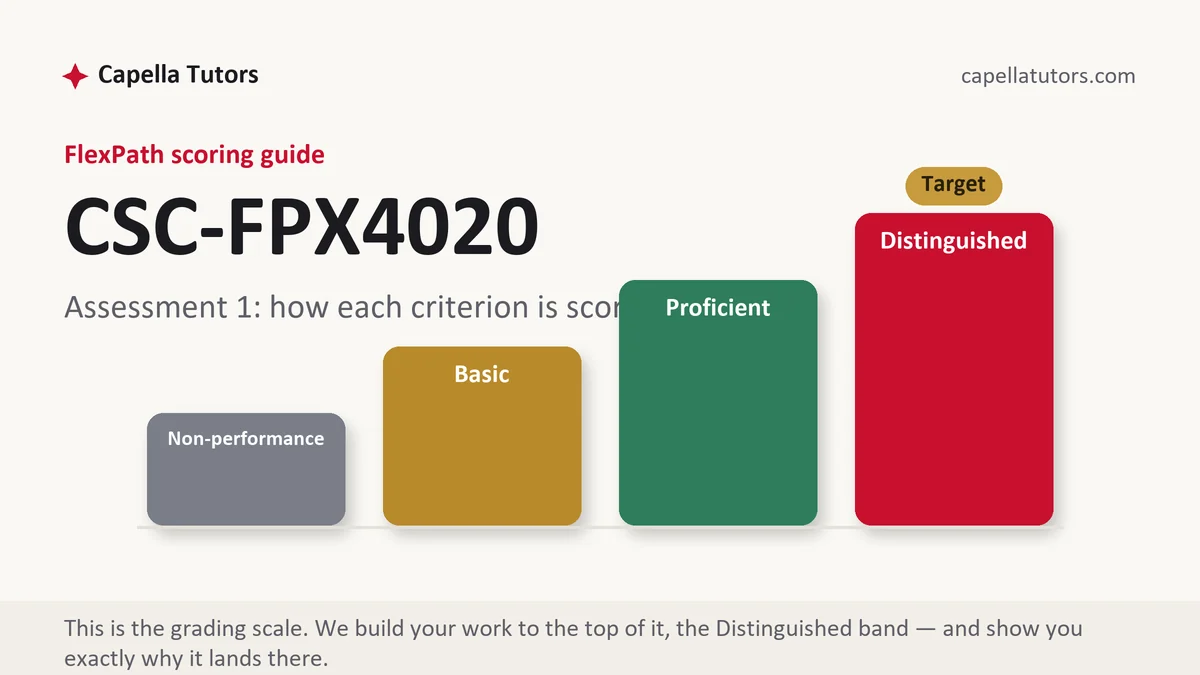
How CSC FPX 4020 Assessment 1 is scored
There is no percentage at the end of this. Each criterion in the guide is placed at one of four levels, and those levels are the specification for your writing:
| Level | What it means on a sorting comparison |
|---|---|
| Distinguished | The bound is derived by counting the dominant operation, best and average and worst are kept apart, and the measured timings are read against the predicted growth. Where the numbers disagree with the theory, the paper names the reason. |
| Proficient | Correct bounds, both procedures explained, timings reported. Everything present, with the numbers left to speak for themselves. |
| Basic | Complexity classes announced in the opening paragraph and never shown coming from anywhere. Common, and it is the version of this deliverable that graders see most. |
| Non-performance | Something the criterion required is simply not in the document, most often the worst case or the analysis of the second procedure. |
The habit worth building now is naming what you count. An order of growth means nothing until a reader knows whether the letter stands for records, characters, or comparisons, and fixing that in the first paragraph makes every later claim checkable.
The CSC FPX 4020 Assessment 1 method, step by step
-
Build the outline out of the criteria, not the textbook chapter
Each criterion becomes a heading and its Distinguished wording goes underneath as your target. Then add one line at the top of the document defining what the input size counts, because every bound in the paper will be read against that definition.
-
Choose two procedures that disagree on your input
The comparison only teaches something if the two candidates behave differently on the data you have. A quadratic sort and a linearithmic one on shuffled data give a predictable answer, while the same pair on nearly ordered data gives a surprising one, and a surprising result is easier to write a Distinguished paragraph about.
-
Derive each bound by counting, on paper
Find the operation that repeats most, count how many times the input forces it, then drop whatever ceases to matter as the input gets larger, with a line of justification behind each of those decisions. That is a derivation, and it is what an undergraduate criterion is asking for when it says analysis. A stated class with no counting behind it is a quotation.
-
Separate the three cases and say what triggers each
Best, average, and worst are three answers, and a paper offering one has covered a third of the question. Describe the arrangement of input that produces each case, since a reader who knows what triggers the worst case can tell whether your data will ever reach it.
-
Measure at several sizes and interpret the ratios
Run both procedures at three or four sizes, each roughly ten times the previous one, repeat each size enough to smooth out noise, and note the hardware, the language version, and whether the timer was started before or after the data was generated. Then print the ratios beside the times, because the interpretation of those ratios is where the marks are.
-
Read the draft as an evaluator would, then self-score
Check that every bound names its operation, every case names its trigger, and every timing names its environment. Assign yourself a level on each criterion and rewrite anything below the top one before the file goes anywhere.
A structure that maps to the criteria
The lengths below are the planning targets our tutors work to on a comparison of this kind, not Capella rules; grow any section your own guide leans on.
| Section | What it must do | Guide |
|---|---|---|
| Problem and input | The data being sorted, its size, its arrangement, and a sentence fixing what the input size counts. | ~150 words |
| The two procedures | How each one works, in enough detail that the reader can see the operation you are about to count. | ~250 words |
| Derivation | The dominant operation counted for each procedure, terms discarded with reasons, and the three cases separated. | ~350 words |
| Measurement | Timings at several sizes with the environment stated and the timing method described. | ~250 words |
| Reading the numbers | Measured growth ratios set against predicted ones, and a cause named for any divergence. | ~250 words |
| References | Algorithm texts, library complexity guarantees, and current APA reconciled both ways. | as needed |
Annotated sample excerpt
An original model excerpt written by our team. It is study material for the register, not a document to submit.
The export arrives almost in order, which is the fact that decides this comparison: 60,000 attendance rows of which roughly 900 sit out of place after a late edit.1 Insertion sort costs one shift for every inverted pair plus one pass to notice the ordered ones, so on this input it performs about 61,000 operations rather than the 900 million a shuffled copy of the same file would force, while merge sort divides and merges the same number of times whatever order the rows arrive in.2 Measured on one laptop, insertion sort finished the export in 0.03 seconds and the shuffled copy in 4.3 seconds, and merge sort took 0.07 seconds on both, which is the shape the derivation predicted: the adaptive procedure wins by a factor of two on data that is already nearly sorted and loses by a factor of sixty when it is not.3
- 1Opens on the property of the input that makes the comparison interesting. No definition of sorting, no history, and the evaluator meets the deciding fact in the first line.
- 2Derives both costs by naming the operation counted, and puts the two counts in the same sentence. This is the move a criterion means by analysis.
- 3Sets measured behavior against predicted behavior and states the exchange in one clause. Numbers with an interpretation attached separate this column from the one below it.
The full premium sample for your exact assessment, written fresh to your scoring guide and issue, is free to request. Study it, revise it into your own voice, and submit work you understand.
The five mistakes that cost Distinguished
- A complexity class quoted from memory. Announcing a bound in the opening line and never counting anything is the classic Basic submission here.
- Growth stated without saying what grows. A bound is unreadable until the reader knows what the input size is counting.
- One case analysed. The criterion asks for best, average, and worst, and two of the three are missing.
- A single timed run. One measurement on a busy machine is a report about the machine.
- Timings that contradict the theory and are printed anyway. An unexplained gap reads as carelessness, and the explanation is usually the best paragraph available to you.
Pre-submission checklist
- A line near the top defining what the input size counts
- Both procedures explained to the level of the operation being counted
- Each bound derived by counting, with the discarded terms justified
- Best, average, and worst separated, each with the input arrangement that triggers it
- Timings at three or more sizes, with machine, version, and timing method recorded
- Measured ratios compared with predicted ones, any divergence explained, APA reconciled both ways
Comparison due and the derivation will not come out?
Send the problem, the criteria, and any code you already have. Back comes the counting, the three cases with their triggers, the timing table on stated hardware, and the paragraph that reads the ratios out loud, inside 24 to 48 hours with revisions free until the guide is met. Nothing to pay on the first sample.