Hand us the scenario, the scoring guide, and any network detail you are allowed to share, and a premium original sample returns inside 24 to 48 hours with each defensive measure tied to a specific attack behavior, a sensor that would catch it, and a stated fallback for when that sensor misses. Your transcript will show this one as IT FPX 4070, Cyber Defense and Countermeasures, three program points inside the Information Assurance and Cybersecurity specialization, taught in FlexPath within a BS in Information Technology that requires at least 90 program points with a minimum of 27 of them earned at the 3000 level or above. In Capella's catalog the course code is written IT-FPX4070.
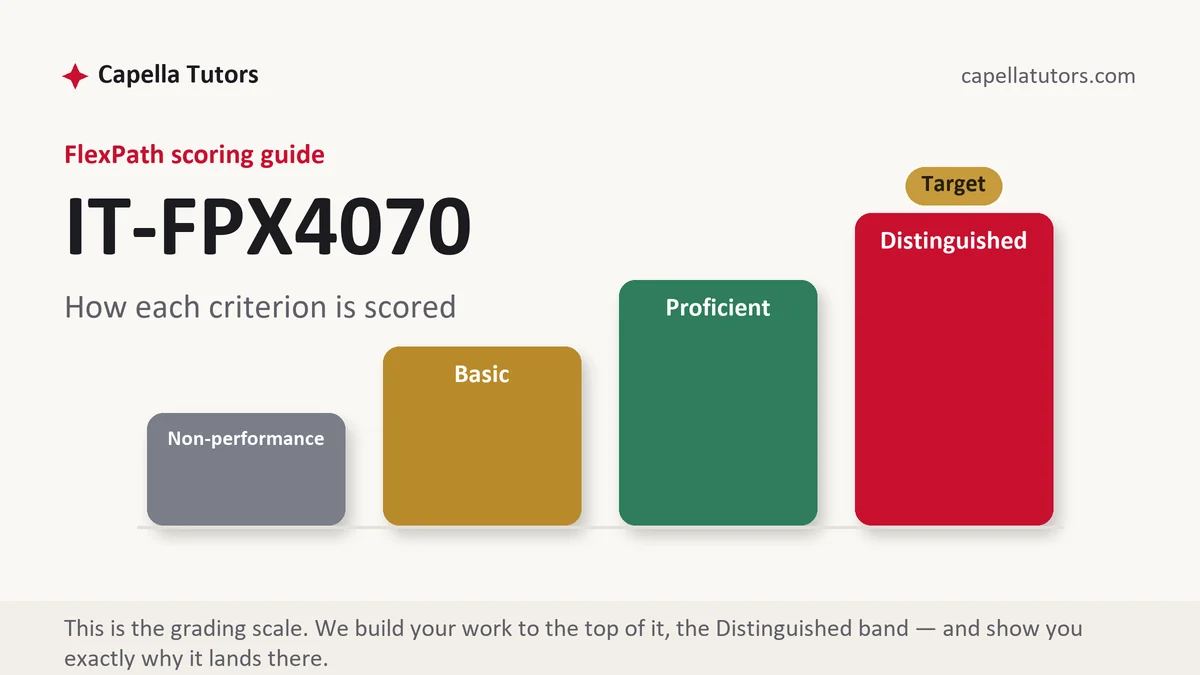
What IT FPX 4070 actually grades
The examiner in this course is looking for a defender who buys nothing until a threat has been named. Deliverables that open with a product catalog collapse on the analysis row, because the criteria are written around a sequence: describe the environment, identify the adversary behavior that environment invites, select a countermeasure that interrupts that behavior, and say how you would know the countermeasure worked. Defense in depth is graded as an argument rather than as a slogan, so layers have to differ in kind. Two firewalls in a row are one layer bought twice. A boundary control, a host control, an identity control, and a monitoring control are four layers, because an attacker who defeats one still meets an unfamiliar obstacle at the next. Control functions carry the weight here, and they are worth separating in writing: preventive measures stop the action, detective measures notice it, corrective measures undo the damage, and compensating measures substitute for something the organization cannot deploy. A paper that labels each recommendation with its function reads as engineering, and one that calls everything security reads as a summary.
Segmentation is the structural skill the course keeps returning to. A flat network converts one compromised workstation into an enterprise incident, so the graded move is to divide the estate by trust and by function, then justify each boundary by what crosses it. Say which zone holds the servers that must never initiate outbound sessions, which holds the workstations that browse the internet all day, where administrative access originates, and what a jump host is for. Egress filtering deserves its own paragraph because most submissions forget that traffic leaves. Inbound rules keep intruders out, and outbound rules keep stolen data and command traffic in, which is the control that actually shortens an incident once prevention has already failed. Rulebases are graded on discipline rather than length, so state a default deny posture, order the rules, name an owner for each exception, and give exceptions a review date.
Monitoring is where the top column separates itself. Intrusion detection reports, intrusion prevention blocks, and the difference decides where you place the device and how much damage a false positive does. Signature methods catch what is already documented and miss anything new, behavioral methods catch novelty and generate noise, and a serious paper runs both and says which one owns which risk. Logging is graded on selection rather than volume, so name the sources that matter, authentication events, privileged command use, firewall denies, endpoint process creation, and say how long each is retained and who reads it. Detection without a written response is decorative, so every alert in your design needs a threshold, an owner, and a first action. Recovery closes the loop, with backups tested rather than merely scheduled and a restoration time you have actually measured.
How we help in this course
A 4070 order arrives as a defensible design, not a list. We map the scenario onto an adversary model first, then build the control set outward from the assets that matter, labeling each measure preventive, detective, corrective, or compensating and attaching the technique it is meant to interrupt. Every sensor in the design gets a placement justified by what traffic it can actually see, every alert gets a threshold and a named owner, and residual exposure is written down instead of quietly rounded to zero. Give us the host counts, the segments you already run, and any tooling your employer has, and the recommendation will fit that estate rather than an imaginary enterprise.
The commercial terms match everything else the studio does. One premium original deliverable inside 24 to 48 hours, written at the Distinguished descriptor rather than at a passing grade, and eight people between your brief and the file you download: research pulls your guide and the current control references, a subject writer builds the architecture and the argument, a scoring-guide reviewer marks the draft row by row the way your evaluator will, an APA and originality pass reconciles the citations, and an editor takes the last read. Revision costs nothing until the guide is met, faculty comments re-enter the queue free, and since an evaluator has two business days for each attempt, an extra pass before submission is cheaper than a second attempt after one.
The assessments, one by one
Assessment 1
The opening deliverable in Cyber Defense and Countermeasures usually asks you to describe the ground before defending it: the estate drawn in zones, the assets that would hurt to lose, the adversary the estate invites, and the boundaries you would put between them. Read the full Assessment 1 manual.
Assessment 2
The middle deliverable in this course usually asks for the defenses themselves: layers that differ in kind, each measure labeled by the function it performs, each one tied to a behavior it interrupts, and each one priced against what it removes. Read the full Assessment 2 manual.
Assessment 3
The later work in this course usually turns to visibility and recovery: where sensors sit, which logs are worth keeping, what threshold makes an alert worth reading, who responds, and how long a restore actually takes. Read the full Assessment 3 manual.
How to actually write IT FPX 4070: where to begin
Start with the scoring guide open beside the scenario and build a threat model before you write a sentence of prose. Four questions produce it: what would an attacker want here, how would that attacker get in given what the scenario describes, what would they do once inside, and what would that cost the organization. Answer those in a short table and the rest of the deliverable has a spine. Anything you cannot answer from the case becomes a declared assumption at the front of the document, because an assumption you announce is analysis and an assumption you hide is invention. Then draw the environment once, label the zones, and keep every later recommendation pointing at something on that drawing.
Next, learn to defend a detection threshold with arithmetic, because this is the calculation that separates a graded analysis from an opinion. Take a sensor watching 200,000 sessions a day on a network where roughly 20 sessions are genuinely hostile. Assume the sensor catches 99 percent of the hostile traffic, so it flags about 20 of them, and assume it misfires on 1 percent of the benign traffic, which is about 2,000 alerts from the 199,980 sessions that were harmless. The console now shows around 2,020 alerts of which 20 matter, so roughly one alert in a hundred is real. That number is the reason analysts stop reading a queue, and it is the argument for tuning, for correlation rules that require two independent signals before an alert fires, and for enrichment that adds asset value to a raw event. Write that calculation into the paper and the criterion for evaluating countermeasures answers itself.
Close with the part most drafts skip, which is what happens when the design fails. Give each significant control a bypass you have already thought about, then state the compensating measure that covers it. Multifactor authentication reduces credential theft and does not stop a stolen session token, so session lifetime and reauthentication for sensitive actions belong in the same paragraph. Application allowlisting stops unsigned binaries and does not stop a signed interpreter running a hostile script, so script logging belongs beside it. Finish with cost, sequence, and a measure of success for each recommendation, since a committee funds a plan with a first step and a way to check it, not a wish list ranked by severity.
| Section | What goes in it | What Distinguished looks like |
|---|---|---|
| Environment and assets | The estate described in zones, with the systems and data that would actually hurt to lose. | Assets ranked by consequence, with the drawing and the narrative naming the same components. |
| Threat model | Adversary type, likely entry, likely behavior once inside, and the reference used to support it. | Behaviors drawn from cited threat reporting for that sector rather than from a generic hazard list. |
| Layered countermeasures | Boundary, host, identity, and data controls, each labeled by the function it performs. | Layers that differ in kind, each interrupting a named step in the attack path. |
| Detection and logging | Sensor placement, log sources, retention, alert thresholds, and who responds. | Placement justified by visibility, thresholds justified by volume, and every alert owned. |
| Response and recovery | Containment steps, eradication, restoration, and the measured time each takes. | Recovery objectives tested rather than asserted, with the test date stated. |
| Sources and format | Control catalogs by revision, threat references by year, peer-reviewed work, current APA. | Standards cited directly, every figure dated, and the reference list reconciled both ways. |
Developing the analysis
The unsettled question in defensive security is where the next dollar goes, and taking a side lifts the analysis criterion. The prevention argument says an intrusion you stop costs nothing to investigate, so harden, patch, segment, and remove the administrator rights that make everything else easy. The detection argument answers that prevention has been failing for thirty years, that intruders sit undiscovered for weeks in published incident data, and that money spent on visibility shortens every breach that does happen. Both positions are defensible and the interesting work is in the division. Argue it with the environment in front of you: an organization with unpatched internet-facing services and shared local administrator passwords should spend on prevention first, because it has no scarcity of easy entries to detect. An organization already patched and segmented gains more from a log pipeline and a person to read it, because its remaining risk is the intruder who arrives with valid credentials and looks like an employee. Then say what your recommendation does not cover. A defender who names the gap sounds like someone who has run a network, and that is the voice the top column describes.
Citations that survive faculty review
Four families of source carry a defense paper. Control catalogs and technical guidance come first, principally the National Institute of Standards and Technology publications on security and privacy controls, on firewalls and firewall policy, on intrusion detection and prevention systems, and on log management, together with the Center for Internet Security Critical Security Controls where you want a prioritized order of work. Adversary behavior needs a structured reference, and the MITRE ATT and CK knowledge base is the one faculty recognize, cited by technique identifier so a reader can verify the mapping rather than take your word for it. Current threat activity comes from advisories published by the Cybersecurity and Infrastructure Security Agency and from annual industry incident reports, both of which must carry the publication year inside your sentence, since a dwell-time figure quoted without a date is worthless. Peer-reviewed research retrieved through the Capella library supports anything you claim about analyst workload, alert fatigue, or the effectiveness of a control class. Two habits keep the reference list clean: give versioned publications their revision number, and keep vendor material clearly labeled as vendor material, because a product datasheet is evidence of a claim rather than evidence of a fact.
The mistakes that land Basic instead of Distinguished
- Products named where functions were asked for. A criterion about countermeasures wants the capability and the reason, not a brand.
- A sensor placed where the traffic never goes. Monitoring inside a switch that never carries the flow you care about detects nothing.
- No egress rules anywhere in the design. Blocking arrivals while ignoring departures leaves the exfiltration path wide open.
- Alerts with no threshold and no owner. An unowned alert is an unread alert, and the design has to say who reads it.
- Every recommendation rated critical. Uniform severity tells a reader that no prioritization happened.
IT FPX 4070 questions students actually ask
Do I have to build a lab or capture real traffic for this course?
Check the wording of your own scoring guide before you build anything, since the deliverables at this level are usually written as designs, analyses, and recommendations rather than as operational exercises. When a criterion does call for evidence of hands-on work, run it inside virtualization software on hardware you own, keep the virtual machines on an isolated adapter, and capture only traffic you generated yourself. Do not scan, probe, or sniff a network that belongs to an employer, a school, or a neighbor, because consent is the entire difference between an assignment and a criminal offense in most jurisdictions. If the prompt seems to require live activity on a production network, ask your faculty member for the boundary in writing and keep the reply.
How do I decide between deploying a countermeasure and accepting the risk?
Put both options in the same units and let the comparison do the arguing. Estimate what the event would cost if it happened and how often you expect it, then compare that annual figure against the full cost of the control, which is the purchase, the deployment labor, and the ongoing operation that everyone forgets. When the control costs more than the exposure it removes, acceptance is the professional answer and you write it down as a decision with a named accepting authority and a review date. Two exceptions override the arithmetic: a regulator requiring the control regardless of cost, and a consequence the organization could not survive at any probability. Say which case you are in and the criterion for evaluation has been answered.
How much of the network needs to appear in my diagram?
Enough that every control you recommend has somewhere to sit, and no more. Draw the trust zones, the boundary between them, the systems holding the data the scenario cares about, the path an administrator takes to reach them, and the point where traffic leaves for the internet. Leave out desk-level detail nobody will grade. Label the drawing with a legend, number the components, and refer to those numbers in the prose so a reader can follow your recommendation to a place on the page. If a second view is needed to show where sensors sit, make it a second diagram rather than crowding the first, since an unreadable picture costs you the criterion it was meant to earn.
Defense plan due this week?
Send the scenario and the criteria. Every countermeasure comes back tied to a named technique, a sensor, and a fallback. The first premium sample is free.