This manual is for COM FPX 3700 Assessment 3, start to submission. The final deliverable in Conflict Resolution usually asks the question the earlier ones set up: how would you know whether the resolution held. An indicator somebody could check, a date, an owner, a plan for the agreement breaking down, and an honest account of what the approach cannot fix are what the criteria buy. What our tutors put in a plan like this is next, with the sections the rows ask for and an excerpt marked up. Rather hand the plan over? A premium original plan written to your own criteria arrives inside 24 to 48 hours, and revisions run free until the guide is met. Capella's catalog lists the course as COM-FPX3700, and some courserooms print COM3700; both point to this same Assessment 3.
One honesty note before the manual: Capella revises courses and scoring guides over time, so always write to the exact scoring guide attached to your assessment in the courseroom. The course identity above is verified on capella.edu; the method and structure below are our tutors' approach to it, not Capella's official rubric text.
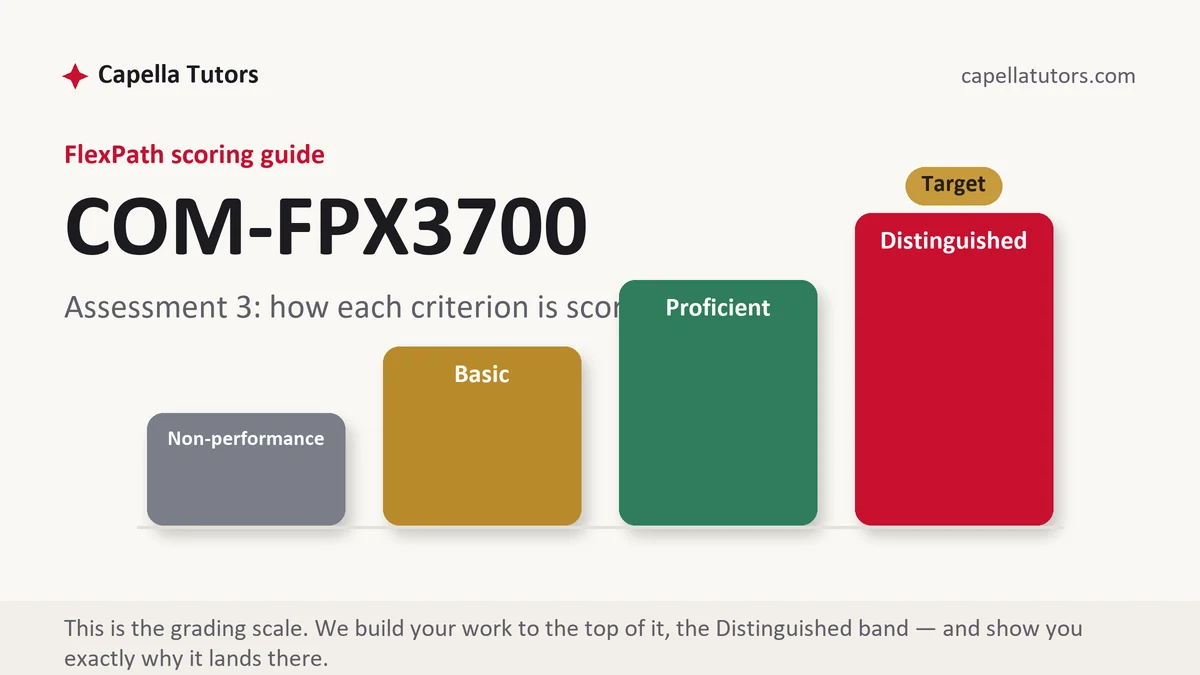
How COM FPX 3700 Assessment 3 is scored
Rows are scored one at a time at one of four levels, with no letter grade produced at the end, so the level wording is the whole instruction:
| Level | What it means on an evaluation and follow-up plan |
|---|---|
| Distinguished | The agreement is written in terms somebody could verify, each indicator has a source, an interval and an owner, the plan says what happens if the agreement fails, cited evidence carries its design and its limit, and the paper names what no amount of skilled conversation will fix. The column itself names the move past Proficient; read it and make that move. |
| Proficient | A clear agreement with a reasonable follow-up plan behind it. Good work, one move below the row above it. |
| Basic | An agreement summarized as improved communication, with a promise to monitor the situation. Where first attempts usually come to rest. |
| Non-performance | A required element is absent, most often the evaluation itself, or the date and owner the check depends on. |
This is where conflict papers most often lose the last row, because an agreement with nothing to check reads as a hope rather than a plan. General education or not, the behavior being graded is the one a supervisor would want: name the indicator, name the date, name the person.
The COM FPX 3700 Assessment 3 method, step by step
-
Write the agreement in verifiable terms
Improved communication cannot be checked. The shared calendar is the only booking record, bookings open on Monday at 9 a.m. for the following week, and no more than two consecutive evening slots go to one project can be checked by anybody with access to the calendar. If a term in your agreement cannot be verified, replace it before you write the plan.
-
Choose indicators with sources, not impressions
Two or three, each with where the number comes from: double bookings per month from the calendar, unresolved override requests from the supervisor's log, and one attitudinal measure collected the same way each time. Say which is the primary indicator, because a plan with five equally weighted measures has not decided what success means.
-
Put a date and an owner on every check
A check with no owner does not happen. Name the person, the interval and the first date: the coordinator reviews the calendar on the first Monday of each month, starting 5 October, and reports to both project leads in writing. Write the dates out rather than implying them with regularly, since regularly is how a follow-up plan dies.
-
Plan for the agreement failing
Say in advance what a breach looks like, what happens on the first one, and what happens on the second. A first double booking is corrected without a meeting; a second in the same month reopens the schedule conversation with both leads present. Deciding this while nobody is angry is the whole value of writing it down.
-
Keep the evidence honest
Where you cite research on what your approach achieves, report its design and its limit in the same sentence. Carsten De Dreu and Laurie Weingart's 2003 meta-analysis found both relationship and task conflict associated with lower team performance, drawn largely from field studies of existing teams, so it cannot tell you which way the arrow runs. That clause is the difference between the top two rows.
-
Name what this cannot fix, then score yourself
Close on the limit: a difference in authority, a budget that will not stretch, or a policy neither party can change is not resolved by a better conversation, and saying so is judgment rather than defeat. Then mark each criterion N, B, P or D against your own draft and submit early in the week, since an attempt can sit two business days before it is read.
A structure that maps to the criteria
The figures in the last column are the planning targets our tutors use for an undergraduate follow-up plan; they are not Capella rules, and your scoring guide overrules them.
| Section | What it must do | Guide |
|---|---|---|
| The agreement | What was agreed, written in terms a third party could verify, with the date it takes effect. | ~200 words |
| Indicators | Two or three measures, each with its source and its interval, and one of them named primary. | ~250 words |
| Check schedule | Who reviews what, how often, starting when, and how the result gets reported. | ~200 words |
| If it breaks down | What counts as a breach, what happens on a first one, and what happens on a second. | ~250 words |
| Evidence and its limits | Research cited with design and limitation in the same sentence, and what it cannot establish. | ~250 words |
| What this cannot fix, and references | The structural limit named, plus current APA with frameworks cited to their authors. | ~180 words |
Annotated sample excerpt
A model passage from our team, showing the section most drafts leave as a promise. Learn how each term is made checkable, then write the plan your own case needs.
From 5 October the shared calendar is the only booking record for the laser cutter and the resin printer, bookings for the following week open at 9 a.m. each Monday, and no single project holds more than two consecutive evening slots.1 The makerspace coordinator reviews the calendar on the first Monday of each month, counting double bookings and override requests, and sends both project leads a two line summary the same day; the double booking count is the primary indicator and three in a month is the threshold.2 A first double booking is corrected by the coordinator without a meeting, a second in the same month reopens the schedule conversation with both leads present, and the whole arrangement is reviewed on 6 April whether or not anything has gone wrong.3
- 1Every term of the agreement is something a third party could confirm from a record, which is what makes the rest of the plan possible at all.
- 2The indicator has a source, an interval, an owner and a threshold, and the paper says which measure decides. A plan without a primary indicator has not defined success.
- 3Failure is planned for while nobody is angry, and the review carries a date whether or not there is a problem, which is the part most drafts leave out.
The full premium sample for your exact assessment, written fresh to your scoring guide and issue, is free to request. Study it, revise it into your own voice, and submit work you understand.
The five mistakes that cost Distinguished
- Improved communication as the agreement. Nothing in the phrase can be checked, so the evaluation row has nothing to grade.
- Monitoring with no owner. A check that belongs to everybody belongs to nobody, and it does not survive the first busy month.
- Regularly, periodically, as needed. An interval with no date attached is how a follow-up plan quietly stops existing.
- No plan for a breach. Deciding what happens after the first failure while both parties are calm is the cheapest insurance in the document.
- Research reported without its design. A finding asserted flatly costs a row that one clause about method and limitation would have secured.
Pre-submission checklist
- Every term of the agreement is verifiable from a record
- Two or three indicators, each with a source and an interval, and one named primary
- Every check carries an owner and a written-out first date
- A breach is defined, with first and second responses decided in advance
- Cited research carries its design and its limit in the same sentence
- One structural limit named, frameworks cited to their authors, self-scored D on every row
Follow-up plan due and nothing in it can be measured?
Send the agreement, the case and the criteria. A team of eight, including a research analyst and two QA reviewers, returns a premium original plan in 24 to 48 hours with verifiable terms, indicators that carry sources, and a breach plan decided in advance.