This manual is for COM FPX 3700 Assessment 2, start to submission. The middle deliverable in Conflict Resolution usually asks you to apply a named framework rather than mention one, and applied means running your case through every part of it. Positions separated from interests, options generated before anything is chosen, an objective standard nobody owns, and each side's alternative if no agreement is reached are what the criteria buy. The method follows, then the section order the rows produce, then one paragraph of the framework annotated. Want the framework applied for you? A premium original sample built to your own scoring guide comes back within 24 to 48 hours, with revisions at no charge until the rows clear. Capella's catalog lists the course as COM-FPX3700, and some courserooms print COM3700; both point to this same Assessment 2.
One honesty note before the manual: Capella revises courses and scoring guides over time, so always write to the exact scoring guide attached to your assessment in the courseroom. The course identity above is verified on capella.edu; the method and structure below are our tutors' approach to it, not Capella's official rubric text.
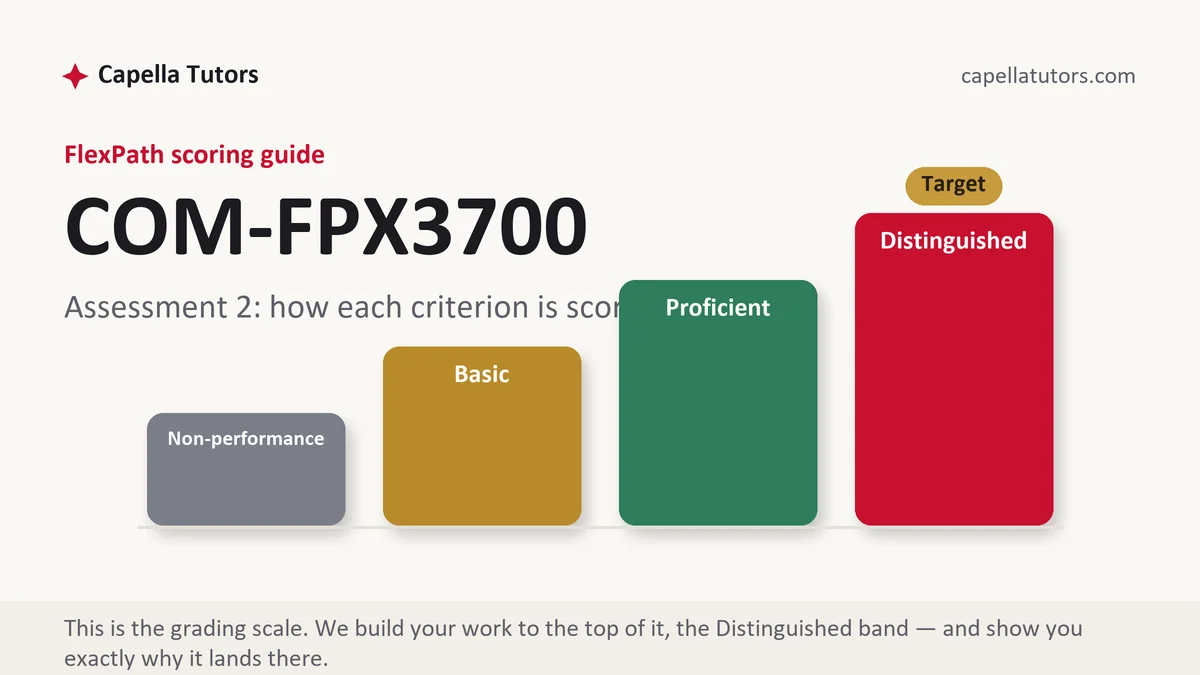
How COM FPX 3700 Assessment 2 is scored
Each criterion is marked at one of four levels and nothing is averaged into a letter, so the level description is the specification you are writing to:
| Level | What it means on an applied framework |
|---|---|
| Distinguished | One framework is named, cited to its primary source, and run across every element of the case including the elements that do not flatter your side; the mediation language is written out; and the standard the agreement rests on belongs to neither party. That further move is printed in the top column, and doing it on purpose is the difference. |
| Proficient | The framework applied accurately across most of the case, with a defensible outcome. Solid work, one row below the top. |
| Basic | A paragraph of theory followed by four of narrative, or a tour of three models with none of them used. The classic shape of a first attempt. |
| Non-performance | A required element is absent, most often the objective standard, or the alternative each party holds if nothing is agreed. |
Applied depth is what separates the top two rows here, and it is cheaper to produce than breadth. One framework used to the end, with the parts that embarrass your preferred outcome included, outscores three frameworks named in passing every time.
The COM FPX 3700 Assessment 2 method, step by step
-
Choose one framework and say why in one sentence
Pick by what the case needs. Where something is genuinely being divided or scheduled, interest-based bargaining fits, because it supplies positions, interests, options, objective criteria and each side's alternative. Roger Fisher and William Ury set it out in 1981 and that is the citation, not the textbook chapter summarizing them, which an evaluator can spot in a reference list without reading your prose.
-
Write the positions in the parties' own words
A position is the demand as stated: every ticket from this office is priority one, against tickets are ranked by the published severity matrix and by nothing else. Quote them, because a position paraphrased into reasonableness has already lost the tension the framework needs to work on.
-
Find the interests, including the ones nobody says out loud
Under the regional office's demand is a payroll deadline on the fifth of each month and a manager judged on whether it clears. Under the desk's position is a queue metric and a fear that one exception becomes the rule. Neither interest contradicts the other, which is the discovery the framework exists to produce.
-
Generate options before you evaluate any of them
Write five and judge none: a standing priority window on the first three days of the month, a named contact who can escalate twice a month, a shared view showing where a ticket actually sits, a scheduled call before payroll runs, a change to the severity matrix itself. Options invented after a preference has formed all resemble the preference.
-
Find a standard neither party owns
The published severity matrix, the service level agreement, the payroll calendar, or the vendor's response time commitment. A standard both sides can read settles the question without either of them conceding to the other, and an agreement resting on goodwill has nothing to hold it once the people change.
-
Name each side's alternative, then write the words
Say what each party faces if nothing is agreed: an executive imposing a rule neither wants, or the regional office routing work around the desk entirely. That is what makes trading rational. Then write the actual sentences of the conversation, including how you would answer a refusal, mark each row yourself, and submit early in the week.
A structure that maps to the criteria
Treat the last column as our tutors' planning targets for an undergraduate applied-framework paper rather than as Capella rules; the guide decides the real proportions.
| Section | What it must do | Guide |
|---|---|---|
| The case in brief | The dispute, the parties by role, and what each has done about it so far. | ~200 words |
| Positions | What each side demands, quoted rather than summarized into reasonableness. | ~150 words |
| Interests | The reason underneath each demand, including the interests neither party has stated aloud. | ~300 words |
| Options generated | Five or more possibilities written before any is judged, with none of them evaluated yet. | ~250 words |
| Standard, alternatives and the choice | The objective criterion, each side's alternative if no agreement is reached, and the option chosen against both. | ~280 words |
| The conversation and references | The words you would use, including a response to refusal, plus primary citations for the framework. | ~200 words |
Annotated sample excerpt
A model paragraph from our team, taken from the move the Basic column skips. Study how the demands become interests, then run your own case through the same step.
The regional office's position is that every ticket it files should be ranked priority one; the service desk's position is that tickets are ranked by the published severity matrix and by nothing else.1 Underneath the first is a payroll run that has to clear by the fifth of each month and a manager whose review names that deadline; underneath the second is a first-response metric the desk reports weekly and a well-founded fear that one standing exception becomes six.2 Neither interest requires the other to lose, which is why the option list opens with a priority window covering the first three working days of the month rather than with a ruling on whose position is correct.3
- 1Both positions appear as stated, in the parties' own terms, so the framework has real tension to work on rather than a softened version of it.
- 2Each interest is specific, dated and tied to something the party is measured on, which is what makes it tradeable. The desk's fear is credited rather than dismissed.
- 3The paragraph ends by moving to options instead of to a verdict, which is the step first attempts leave out.
The full premium sample for your exact assessment, written fresh to your scoring guide and issue, is free to request. Study it, revise it into your own voice, and submit work you understand.
The five mistakes that cost Distinguished
- A framework named once and abandoned. One paragraph of theory followed by four of narrative reads as decoration and is scored that way.
- Positions rewritten as interests. If the interests section repeats the same demand in gentler language, the framework has not been applied.
- Options evaluated as they are invented. A list generated after a preference has formed contains five versions of the preference.
- A standard owned by one side. Our own department's service policy is not an objective criterion to the party who did not write it.
- The textbook cited for the framework. Summaries sitting in a reference list where the primary sources belong are visible without reading a word of the paper.
Pre-submission checklist
- One framework named and cited to its primary source
- Positions quoted in the parties' own words
- Interests specific, tied to what each party is measured on, including unstated ones
- Five or more options written before any evaluation
- An objective standard neither party owns, plus each side's alternative if nothing is agreed
- The conversation written out including a response to refusal, self-scored D throughout
Framework due and the model keeps sliding off the case?
Send the case, the framework your courseroom is using and the criteria. A team of eight, including a research analyst and two QA reviewers, returns a premium original sample in 24 to 48 hours with every element of the framework applied and the conversation written out, revised free until the guide clears.