This manual is for COM FPX 3700 Assessment 1, start to submission. The opening deliverable in Conflict Resolution usually asks you to describe a dispute before you do anything about it, and the description is where most of the marks are. A record a stranger could check, a conflict type named and defended, the level it sits at, and what is genuinely at stake are what the criteria buy. Our tutors' method is below, with the sections the rows imply and a case record marked up in the margin. Prefer to hand the case across? A premium original sample written to your own criteria arrives inside 24 to 48 hours, revised free until every row is satisfied. Capella's catalog lists the course as COM-FPX3700, and some courserooms print COM3700; both point to this same Assessment 1.
One honesty note before the manual: Capella revises courses and scoring guides over time, so always write to the exact scoring guide attached to your assessment in the courseroom. The course identity above is verified on capella.edu; the method and structure below are our tutors' approach to it, not Capella's official rubric text.
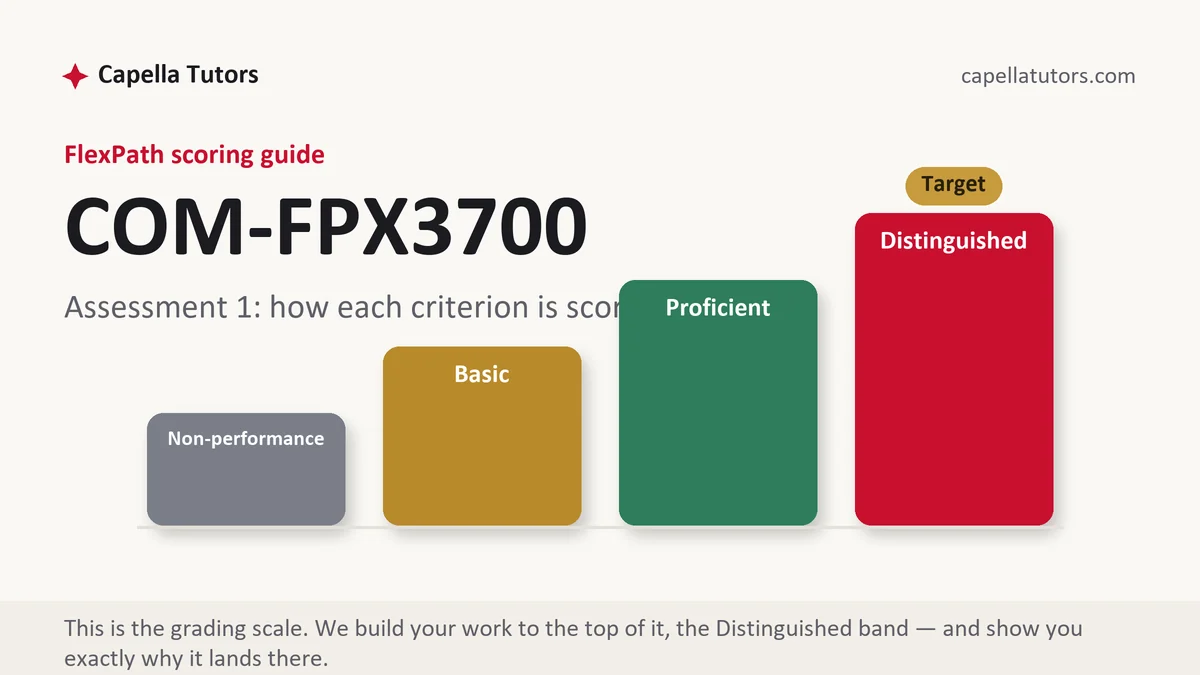
How COM FPX 3700 Assessment 1 is scored
FlexPath produces no letter grades. Each row on the scoring guide is marked at one of four levels, and the wording inside the level is the brief you write to:
| Level | What it means on a conflict diagnosis |
|---|---|
| Distinguished | The case is written as observable record with words and sequence attached, the conflict type is named and defended from that record, the level and the stage are identified, the parties' interests are separated from their positions, and behavior is explained by situation before character. The step beyond Proficient is named in the column wording, so lift it from there and perform it. |
| Proficient | An accurate account with the conflict type correctly identified and supported. Careful work, one move below the top. |
| Basic | A story summarized as a personality clash, followed by advice. The most common outcome for a first attempt in this course. |
| Non-performance | A required element is absent, most often the diagnosis, where a narrative has been submitted in its place. |
The 3 points here are general education points in the Communication category, and the 3000-level number is worth checking against whatever upper-division minimum your own bachelor's program sets. What the rows grade is not your experience of conflict but whether a reader who was not there can follow your reasoning.
The COM FPX 3700 Assessment 1 method, step by step
-
Turn the rows into headings, then write the record before the reading
Two or three paragraphs of observable fact: who did what, in what order, with the words that were actually used. Most drafts fail here by compressing the dispute into one line about a personality clash and then analyzing a story the reader cannot see. Deidentify as you write, using roles rather than names, and say in one line that you have.
-
Separate what happened from what you concluded
Keep two columns while drafting. The left holds what a camera would have recorded. The right holds your inferences. He wanted to embarrass me belongs on the right and needs left-hand evidence beside it before it can appear in the paper at all. This one discipline protects every criterion that only rewards what the record shows.
-
Name the type, and defend the naming
Disagreement about the work itself, friction between the people, and dispute about how the work is allocated and scheduled are three different objects. Karen Jehn's 1995 study of intragroup conflict is the primary source for the first two, with her later work adding the third. Say which one this is and quote the record that makes it so, because a type asserted in a sentence earns nothing.
-
Locate the level and the stage
A dispute between two colleagues, a dispute between two units, and a dispute with a policy standing behind it need different people in the room. Then say how far it has travelled: a disagreement, a personalized disagreement, or a pattern that has attached itself to unrelated decisions. The level decides who you would invite; the stage decides how much history has to be handled first.
-
Dig for interests underneath the positions
A position is what somebody demands; an interest is why. Two leads arguing about a cutoff time are stating positions, and the interests underneath may be an audit review and a shift handover. Interests are the level where agreements exist, and a diagnosis stopping at positions has left the rest of the paper nothing to work with.
-
Explain behavior by situation first, then score yourself
Before reaching for what kind of person somebody is, name the situation they were standing in: the schedule they were handed, the metric they are judged on, the information they did not have. We reliably do the reverse for other people and the reverse of the reverse for ourselves. Then mark each criterion N, B, P or D yourself and submit early in the week.
A structure that maps to the criteria
Word targets below are the planning numbers our tutors use for an undergraduate diagnosis, not Capella rules; any row your own guide asks more of should grow.
| Section | What it must do | Guide |
|---|---|---|
| The case | Parties by role, the sequence of events, and the words that were used, deidentified where needed. | ~300 words |
| Record against inference | What was observed, kept apart from what you concluded, with the evidence for each conclusion. | ~200 words |
| Type, cited and defended | The conflict type named, attributed to its primary source, and supported from the record. | ~250 words |
| Level and stage | Whether this sits between individuals, units or policies, and how far it has escalated. | ~200 words |
| Positions and interests | What each party demands, and the interest underneath it, listed side by side. | ~250 words |
| What is at stake, and references | The cost of leaving it alone, plus current APA with frameworks cited to their authors. | ~150 words |
Annotated sample excerpt
An original model from our team, written at the register the top of the guide describes. Take the discipline of the record, then write the case you were given the same way.
On three consecutive Fridays the dining hall's front-of-house lead held the order screen open until 7:12, 7:15 and 7:09 p.m., past the 7 p.m. cutoff printed on the posted schedule, and on the third Friday the kitchen lead said, in front of four student workers, that the cutoff was not a suggestion.1 The front-of-house lead replied that she was not sending students away with money in their hands, and neither of them raised it again until the following week's staffing meeting.2 Read from that record, this is a dispute about how the work is scheduled rather than about the two leads, and it became personal only after the third Friday, when the objection was made in front of the crew.3
- 1Times, counts, a posted rule and a quoted sentence, all of them checkable. A reader can now disagree with the writer's reading of the events.
- 2The second party gets their own words and their own reason, so the account does not quietly become one side's brief.
- 3The type is named from the record and the stage is dated to a specific moment, which is what turns a narrative into a diagnosis.
The full premium sample for your exact assessment, written fresh to your scoring guide and issue, is free to request. Study it, revise it into your own voice, and submit work you understand.
The five mistakes that cost Distinguished
- Personality clash offered as a diagnosis. The phrase names no mechanism and leaves the response with nothing to work on.
- Motive reported as fact. He wanted to undermine me is a conclusion, and the rows can only credit what the record shows.
- Only one party quoted. An account giving the other side no words has become an argument rather than a case.
- Positions relabeled as interests. If the interests section restates the same demand in gentler words, the analysis has not happened.
- Identifying detail left in. A named employer and a named colleague in a course paper is the problem the deidentification line was there to prevent.
Pre-submission checklist
- The case gives roles, sequence, times and the words that were used
- Inferences are separated from observations and each carries its evidence
- The conflict type is named, cited to a primary source, and defended from the record
- Level and stage are both identified
- Positions and interests are listed separately for every party
- Deidentification stated, frameworks cited to their authors, self-scored D on every row
Conflict paper due and the case is still a story?
Send the prompt, the criteria and the dispute you have been asked to work with. A team of eight, including a research analyst and two QA reviewers, returns a premium original sample in 24 to 48 hours with the record, the diagnosis and the interests laid out, revised free until the guide clears.